

The most common real estate syndication misconceptions are not about the mechanics — they are about who the investment is for, what the risks actually are, how returns are generated, how liquid the money really is, and what “passive” means in practice. Each of these misunderstandings is reasonable. They come from applying public-market habits to a private-market investment, and they quietly keep many qualified investors on the sidelines. The problem is that a misconception left uncorrected feels like a sound reason to wait, when it is really just a gap in information. Real estate syndication is a structure in which a group of investors pool capital to own a larger property than any of them could buy alone, with a sponsor managing the asset. That structure is well understood. The misreads happen around it. This article walks through the five things accredited investors most often get wrong about real estate syndication, states each misconception plainly and fairly, and then explains what is actually true — so the only thing standing between interest and an informed decision is accurate information.
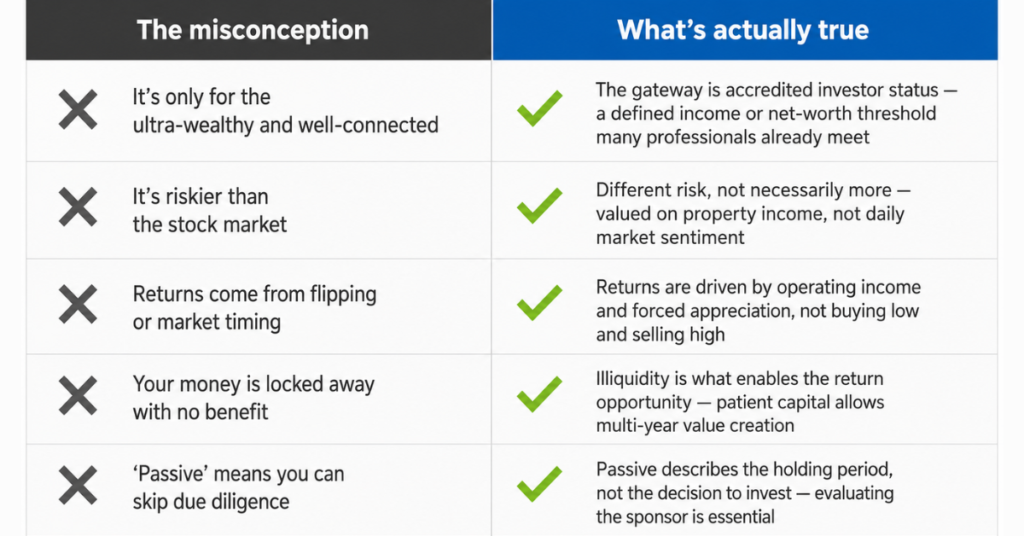
Most real estate syndication misconceptions are about who it’s for and how it works — not the mechanics themselves.
Accountable Equity offers investment opportunities exclusively to verified accredited investors under Rule 506(c) of Regulation D. All investors must meet applicable qualification requirements as defined by the SEC. For a detailed overview of who qualifies as an accredited investor, visit our accredited investor resource page.
In This Article
- Five Misconceptions Accredited Investors Have About Real Estate Syndication
- Frequently Asked Questions
- Correcting the Misconceptions That Keep Qualified Investors Waiting
Five Misconceptions Accredited Investors Have About Real Estate Syndication
The five most damaging real estate syndication misconceptions cluster around the same five questions every investor asks: Who is this for? What are the risks? Where do the returns come from? Can I get my money out? And how passive is it really? Below, each misconception is stated as the reasonable belief it is — then corrected with how the investment actually works.
Misconception 1: Real Estate Syndication Is Only for the Ultra-Wealthy and Well-Connected
This one is easy to believe. Private real estate has long carried an air of exclusivity — country-club deals, family offices, and minimums that sound like down payments on a home. If you built your wealth through a salary, a 401(k), and a brokerage account, it is natural to assume this world is reserved for people who are richer and more connected than you are.
Here is what is actually true. The legal gateway to most private real estate offerings is accredited investor status, not membership in an exclusive club. The SEC defines an accredited investor as someone with $200,000 in individual income (or $300,000 jointly) in each of the last two years with the expectation of the same, or a net worth over $1,000,000 excluding the value of a primary residence. Many professionals, business owners, and dual-income households already meet this standard without realizing it.
Under Rule 506(c) of Regulation D, sponsors can openly discuss these offerings with the public, but they must verify each investor’s accredited status rather than accept a simple self-attestation. That verification step is a protection, not a barrier. The real obstacle is usually awareness, not access — many people who qualify simply never learned this category existed. If you want to confirm whether you meet the standard, our accredited investor resource page lays out the qualification criteria in plain language.
Misconception 2: Syndications Are Riskier Than the Stock Market
This belief comes from a sensible instinct: unfamiliar things feel riskier than familiar ones. A publicly traded stock has a price you can check every second, a long history of disclosures, and the comfort of being able to sell instantly. A private syndication has none of that visible machinery, so it can feel like a leap into the dark.
But visibility is not the same as safety. A stock price that updates every second also swings every second, often on sentiment that has nothing to do with the underlying business. Private real estate is valued on the income the property produces and the value of the asset itself, so it does not lurch with every headline. Different risk, not necessarily more risk.
Real Estate Syndication risk is real and should never be minimized — these investments can lose principal, and past performance never guarantees future results. But the actual risks are specific and knowable: the quality of the sponsor, the strength of the local market, the amount of debt on the property, and the durability of the revenue. A property that earns income across several streams — for example lodging, dining, memberships, and contracted events — generally has more ways to absorb a shock than a single-use building or a single stock. The task is not to avoid risk but to understand which risks you are taking and whether the operator can manage them.
Misconception 3: The Returns Come From Flipping or Market Timing
Many newcomers assume real estate returns are mostly about buying low and selling high — catching the right market at the right moment, the way a stock trader might. From the outside, a big payday at the end of a deal can look like a lucky bet on rising prices.
In a well-structured syndication, that is rarely where most of the value comes from. Returns are typically generated two ways: from the income the property produces while it is held, and from forced appreciation — increasing the asset’s value by improving its operations, not by waiting for the market to rise. A sponsor that raises occupancy, adds revenue streams, controls costs, and professionalizes management can grow the property’s income, and a more profitable property is generally worth more, even when the broader market is flat.
This is why operating ability matters so much, and it is the part of the real estate syndication misconceptions list that sophisticated investors care about most. Consider how the funds offered by Accountable Equity own properties such as Bohemia Manor Farm in Chesapeake City, MD, which is operated by VIVÂMEE Hospitality. Both companies were co-founded by Josh McCallen, who serves as Chief Executive Officer, and Melanie McCallen, who is also a co-founder of both companies and serves as Chief Experience Officer of VIVÂMEE Hospitality. A property like that earns across lodging, wine production, events, and more — and value is created by running those operations well, not by timing a sale.

Bohemia Manor Farm, Chesapeake City, MD — owned by the funds offered by Accountable Equity and operated by VIVÂMEE Hospitality.
Misconception 4: Your Money Is Locked Away With No Real Benefit
For an investor used to public markets, the multi-year hold period of a syndication can feel like the biggest drawback of all. You are accustomed to being able to sell on any given Tuesday. Committing capital for several years with limited ability to exit sounds like pure downside — a loss of control with nothing offered in return.
The reframe is this: illiquidity is not a penalty attached to the investment. It is the mechanism that makes the return opportunity possible. A sponsor who does not have to worry about investors heading for the exit during a rough quarter can execute a multi-year plan — renovating, repositioning, and growing income — without selling at the wrong time. That patient capital is precisely what allows the value to be built.
In other words, the return opportunity exists in part because patient capital accepts a constraint that public-market investors typically do not. The lack of a daily price is not a hidden flaw; it is the reason private assets can behave differently from the stock market in the first place. It also helps to know how distributions typically work: many private real estate offerings, including those offered by Accountable Equity, may distribute on schedules that vary by offering. Review the specific terms in each offeringâs documentation so the right expectation is set from the start.
Misconception 5: “Passive” Means You Can Ignore Due Diligence
Syndications are correctly described as passive investments, and that word does a lot of work in attracting busy professionals. The reasonable but mistaken leap is to assume that “passive” means effortless from start to finish — that once you are a qualified investor, one offering is much like another and the homework is optional.
“Passive” accurately describes the holding period: you are not screening tenants, fixing roofs, or managing staff. It does not describe the decision to invest. The single most important variable in a syndication is the sponsor, because the sponsor’s skill is what turns a property into a return. Choosing one is active work.
Good due diligence asks pointed questions: How long has the operator been in business, and through what kinds of markets? Do they own and operate the assets themselves, or hand management to a third party whose incentives may not align? How many revenue streams does the property have? You can see the criteria in action by reviewing how Accountable Equity structures its offerings and the vertically integrated model behind them. Tax treatment is another area worth careful homework — some private real estate structures offer depreciation benefits, but the outcome depends entirely on your situation, so consult a qualified CPA before drawing any conclusions about your own taxes.
Frequently Asked Questions
What is the biggest misconception about real estate syndication?
The biggest misconception is that real estate syndication is only for the ultra-wealthy. In reality, the gateway is accredited investor status — a defined income or net-worth threshold that many professionals and dual-income households already meet without realizing it. Access is mostly a matter of awareness, not exclusivity.
Is real estate syndication riskier than investing in stocks?
It is not automatically riskier — it carries different risks. Stocks are highly liquid and reprice every second on sentiment, while private real estate is valued on property income and is less reactive to headlines. Both can lose principal. The key risks in a syndication are the sponsor’s quality, the debt level, the local market, and the durability of the property’s revenue.
How do investors actually make money in a real estate syndication?
Returns generally come from two sources: the income a property produces while it is held, and forced appreciation — raising the asset’s value by improving its operations rather than waiting for the market to climb. This is why the operator’s skill matters far more than market timing.
If syndications are passive, why does due diligence matter?
“Passive” refers to the holding period — you are not managing the property day to day. The decision to invest is not passive. Because the sponsor’s ability is the single largest driver of outcomes, evaluating the operator’s track record, alignment, and revenue model is essential work before committing capital.
Correcting the Misconceptions That Keep Qualified Investors Waiting
The most common real estate syndication misconceptions share a single root: they apply public-market reflexes to a private-market investment. Once you see that the barrier is usually awareness rather than access, that the risks are different rather than greater, that returns come from operations rather than timing, that illiquidity is compensation rather than penalty, and that “passive” applies to the holding period and not the homework, the picture changes. The misconceptions were doing much of the work. Whether clearing them up leads to action or to a well-informed decision to wait, either outcome is the right one when it is based on accurate information.
If any of these struck a chord, the next step is education, not action. Learn how the structure works, ask sponsors hard questions, and review our accredited investor resource page to confirm who qualifies and what accredited investors can access.
Up Next in This Series
Next: How Do Alternative Investments Perform During Recessions? What the Data Shows.
IMPORTANT DISCLOSURE
This content is provided for informational and educational purposes only. It is not investment advice or a recommendation, does not constitute a solicitation to buy or sell securities, and may not be relied upon in considering an investment in any Accountable Equity fund.
Real estate syndication investments involve risk, including the potential loss of principal. Past performance is not indicative of future results. Any historical returns, expected returns, or probability projections may not reflect actual future performance.
While data sourced from third parties is believed to be reliable, Accountable Equity cannot ensure its accuracy or completeness. Investment opportunities offered by Accountable Equity are available only to independently verified accredited investors through offerings made in accordance with Rule 506(c) under Regulation D of the Securities Act of 1933.
Each investor should conduct their own due diligence and consult with qualified financial, legal, and tax professionals before making any investment decision. Accountable Equity does not provide legal, tax, or investment advice. This content may contain forward-looking statements. You should not rely upon forward-looking statements as predictions of future events. These statements involve known and unknown risks, uncertainties, and other factors that may cause actual results to differ materially from those expressed or implied. Before making any investment decision, prospective investors are advised to carefully read all related subscription and offering memorandum documents.
© 2026 Accountable Equity. All rights reserved. This content may not be reproduced or redistributed without written permission.