
Diversifying away from the stock market with real assets means owning investments whose return drivers are structurally disconnected from equity market cycles—not just adding another line item to a brokerage account. Most strategies marketed as “diversification” fail this test because the underlying assets still respond to the same macroeconomic forces that move stock prices.
If you held a traditional 60/40 portfolio in 2022, you experienced this failure firsthand. Both stocks and bonds declined simultaneously because both asset classes shared the same vulnerability: sensitivity to rising interest rates. That year challenged a foundational assumption most investors had never questioned—that bonds reliably offset equity losses. The lesson was not that the 60/40 model was temporarily broken. The lesson was that assets sharing common return drivers do not provide true diversification, regardless of how different they appear on a balance sheet.
This post explains what real diversification requires, why most conventional approaches fall short, and how real assets provide the structural non-correlation that paper assets cannot.

Most portfolios labeled “diversified” share the same underlying return drivers. Real assets with independent, operations-based revenue models provide structural non-correlation across multiple asset categories.
In This Article
• Why the 60/40 Portfolio Failed the Diversification Test
• What Does True Diversification Actually Require?
• How Real Assets Provide Structural Non-Correlation
• Why Illiquidity Is a Feature, Not a Flaw
• What Accredited Investors Should Consider Before Making the Shift
• Frequently Asked Questions
Why the 60/40 Portfolio Failed the Diversification Test
For decades, financial advisors built portfolios around a simple formula: allocate roughly 60% to equities for growth and 40% to bonds for stability. The premise was that when stocks declined, bonds would hold steady or appreciate, cushioning the overall portfolio.
In 2022, that premise collapsed. The S&P 500 declined approximately 19%, and the Bloomberg U.S. Aggregate Bond Index fell roughly 13%—both driven by the Federal Reserve’s aggressive interest rate increases. The simultaneous decline was not a coincidence. It was a structural outcome: both asset classes shared the same vulnerability to rising rates. When rates moved sharply, equity valuations compressed and bond prices fell in tandem.
The lesson is not about 2022 specifically. It is about what “diversification” actually means. If two assets respond to the same underlying forces—interest rate policy, inflation expectations, Federal Reserve actions—then owning both is concentration disguised by different labels. For accredited investors who have accumulated significant wealth and want to protect it, the question is not whether to reduce equity exposure. It is whether the replacement is truly independent of the forces driving public markets.
What Does True Diversification Actually Require?
True diversification requires assets whose return drivers operate independently from equity market cycles. This is a higher bar than most investors realize, and it eliminates many strategies that carry the “alternative” label.
Consider what drives returns in public equities: corporate earnings expectations, interest rate changes, investor sentiment, and macroeconomic data. Any asset that depends on the same inputs—corporate bond yields, REIT share prices, publicly traded commodity funds—will tend to correlate with equities during the moments when diversification matters most: market stress.
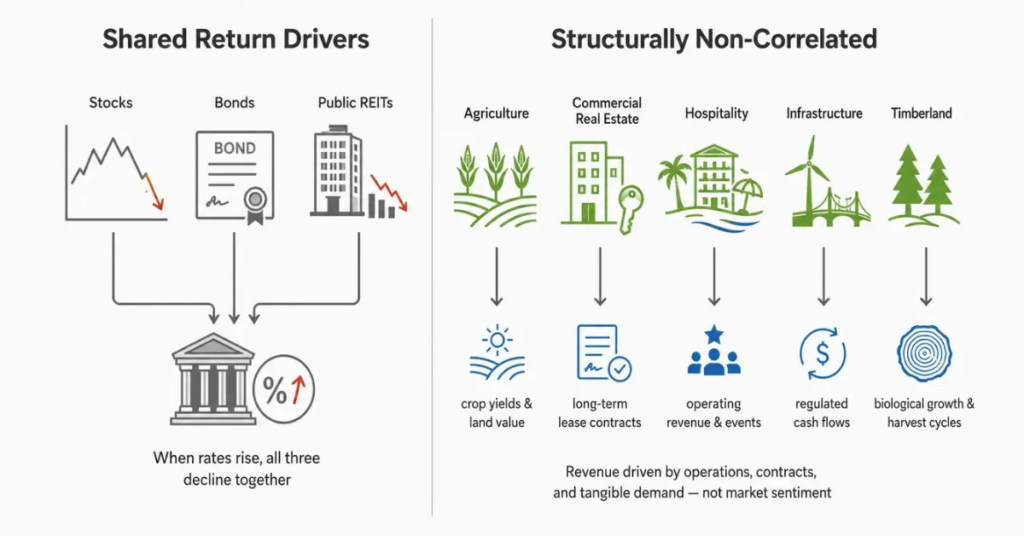
Most portfolios labeled “diversified” share the same underlying return drivers. Real assets with independent, operations-based revenue models provide structural non-correlation across multiple asset categories.
Structural non-correlation means the revenue engine powering an investment operates on a completely different set of inputs. A commercial lease tied to a creditworthy tenant produces rental income regardless of the Nasdaq’s daily movement. A hospitality asset generating revenue from forward-contracted weddings and corporate events is collecting deposits based on social calendars and business planning cycles—not earnings season or Federal Reserve announcements.
The test for any diversification strategy is simple: When public markets are falling, does this asset’s income stream depend on the same forces causing the decline? If the answer is yes, the strategy is not diversifying your portfolio. It is repackaging the same risk.
How Real Assets Provide Structural Non-Correlation
Real assets—physical properties, land, operating businesses anchored in tangible locations—derive returns from fundamentally different engines than public securities. Revenue comes from operations, contracts, and guest demand rather than from market sentiment or discount rates.
In destination hospitality, for example, revenue is generated across multiple streams: lodging, events, food and beverage, golf, and other on-site experiences. A significant portion of that revenue is forward-contracted. Weddings and corporate retreats book twelve to eighteen months in advance, typically secured by non-refundable deposits. These contracts create a revenue floor that is not influenced by the S&P 500’s trajectory.
A bride does not cancel a wedding because the stock market drops. A corporation does not abandon a leadership retreat because bond yields rose fifty basis points. The demand drivers are structurally different from the forces that move public securities—and that independence is what creates genuine portfolio diversification.
For investors evaluating how to build a more resilient portfolio, you can explore how Accountable Equity structures its investment process for additional context on how this type of investment works for accredited investors.
Why Illiquidity Is a Feature, Not a Flaw
One of the most common objections to real asset investing is illiquidity. Investors accustomed to public markets—where they can sell a position in seconds—often view illiquidity as an unacceptable trade-off. That perspective misses a fundamental relationship.
Illiquidity is one of the primary reasons real assets generate the returns they do. In public markets, instant liquidity comes at a cost: you are subject to the behavioral pricing of millions of other participants. Stock prices move on sentiment, algorithmic trading, and headline risk—forces that have nothing to do with the underlying value of the business.
Real assets are valued based on their cash flows, physical condition, and operational performance. Because they cannot be traded on an exchange, they are insulated from the emotional volatility of public markets. For accredited investors with a long time horizon, illiquidity is not a penalty—it is compensation. The investor accepts reduced liquidity in exchange for access to return drivers that liquid markets cannot offer. It is the same principle that explains why a five-year certificate of deposit pays more than a savings account.
To understand what accredited investors can access, including private real estate opportunities, it helps to understand why these investments require verification of accredited status under applicable securities laws.
What Accredited Investors Should Consider Before Making the Shift
Moving capital from public markets into real assets is not a binary decision. A thoughtful approach involves several considerations.
Understand the return drivers. Before committing capital to any private investment, evaluate what generates the income. Is the revenue contractual or speculative? Is the asset operationally complex in ways that create a barrier to entry? Does the operating model depend on the same forces driving the public markets you want to diversify away from?
Evaluate the sponsor. In private real estate, the sponsor’s track record, alignment structure, and team capabilities matter at least as much as the asset itself. Understand who is managing the property, how incentives are structured, and whether the operator has demonstrated execution across market conditions. You can review how to evaluate a real estate syndication sponsor for a structured framework.
Accept the appropriate time horizon. Real asset investments are not short-term trades. Hold periods of five to ten years are common. Investors should allocate capital they do not need for immediate liquidity. Patient capital earns the illiquidity premium that liquid markets forfeit.
Build your own advisory team. Every investor’s tax situation, estate plan, and risk tolerance is different. Before making any investment decision, work with your financial advisor, CPA, and attorney to evaluate how a real asset allocation fits your overall portfolio. This content is educational—it is not a substitute for personalized professional advice.
Frequently Asked Questions
What does it mean to diversify away from the stock market?
Diversifying away from the stock market means allocating capital into investments whose return drivers are structurally independent from equity market cycles. The goal is not simply owning different assets—it is owning assets whose income and value are determined by forces unrelated to public stock prices. Real assets with operating revenue models, forward-contracted income, and tangible physical value are examples that can achieve this structural independence.
Why did the 60/40 portfolio fail in 2022?
The 60/40 portfolio failed in 2022 because both stocks and bonds shared a common vulnerability: sensitivity to rising interest rates. When the Federal Reserve raised rates aggressively, equity valuations declined and bond prices fell simultaneously. The assumption that bonds would offset equity losses proved incorrect because both asset classes were responding to the same macroeconomic force.
Are real assets risky?
All investments involve risk, including the potential loss of principal. Real assets carry specific risks including operational complexity, market-specific demand fluctuations, and illiquidity. However, the return drivers—particularly in assets with contractual revenue and diversified income streams—are structurally different from public market risks. Investors should conduct thorough due diligence and consult with qualified professionals before making any investment decision.
Diversifying away from the stock market is not about finding a better ticker symbol. It is about finding investments whose return engines run on entirely different fuel. Real assets—particularly those with operating revenue models anchored in contracts and guest demand—offer the kind of structural non-correlation that paper-based strategies have struggled to deliver. For accredited investors ready to explore what real diversification looks like in practice, the next step is education: understanding the mechanics, evaluating the operators, and building the advisory team to make an informed decision.