

If your real estate experience has been in multifamily, commercial, or industrial properties, you already have a solid analytical foundation. You understand how to read a rent roll, evaluate vacancy, calculate net operating income, and apply a cap rate to arrive at value. That framework has served you well, and it does not become irrelevant when you look at destination hospitality real estate. But it does need to be extended.
Destination assets — resorts, event-driven properties, winery and golf venues — operate on a different performance logic than traditional real estate. They outperform in specific conditions and carry real risks in others. This post builds that bridge: starting with what you already know, explaining what changes and what stays the same, and covering the questions to ask when evaluating a destination asset for the first time.

Renault Winery Resort, Egg Harbor City, NJ — owned by the funds offered by Accountable Equity and operated by Vivamee Hospitality.
In This Article
• What Traditional Real Estate Gets Right — and Where It Stops Applying
• How the Revenue Model Changes in Destination Hospitality
• The Conditions That Favor Destination Asset Performance
• Where Traditional Real Estate Holds the Edge • Reading the Numbers — From Cap Rates to TRevPAR
• How to Apply This Framework When Evaluating an Opportunity
• Frequently Asked Questions
What Traditional Real Estate Gets Right — and Where It Stops Applying
The performance framework most investors learn in multifamily or commercial real estate is built around a few core concepts. Net operating income measures the revenue a property produces minus its operating expenses, before debt service and capital expenditures — it is the number that drives valuation and tells you whether the asset is generating real economic return. Cap rate translates that income into a valuation. Vacancy tells you how efficiently the rentable space is being utilized. And a rent roll shows you who is paying, how much, and when their leases expire — giving you a forward view of income stability.
These concepts do not disappear when you evaluate destination hospitality. At the fund level, NOI and return on equity still apply. But at the property level — where you are trying to understand whether a specific resort or event venue is performing well or poorly — the traditional metrics stop telling the full story. A destination property does not have a rent roll. It does not have a single tenant or a fixed monthly payment. Its income arrives in multiple streams, at different times, from different sources, and the mix of those streams changes week to week depending on the season, the event calendar, and consumer behavior.
That shift in revenue structure is the core reason destination assets need their own performance framework. The question is not how to replace what you already know — it is how to extend it.
How the Revenue Model Changes in Destination Hospitality
In multifamily, revenue is relatively straightforward: units multiplied by rent, adjusted for vacancy. The income is monthly, contractual, and largely predictable once the rent roll is set. Expenses are also well-defined. The operating model is designed to be managed.
A destination property generates income across several categories simultaneously. Lodging is one component — guests staying overnight, booked by the room or by the night. But alongside lodging there is food and beverage, which in a well-run resort can represent a substantial share of total revenue. There are weddings and corporate events, which are booked months in advance under contracts that commit the guest to a venue fee and defined service package. There are recreational amenities — golf, spa, vineyard experiences — each with their own pricing and demand patterns. There is often retail.
Each stream behaves differently. Lodging demand is sensitive to travel confidence and seasonal patterns. Event revenue is largely contractual — a booked wedding does not cancel because the stock market drops. Food and beverage can draw local customers independent of overnight stays. The multi-stream model gives the property more levers to pull when one source softens, but it also means more variables to manage. Whether that complexity creates strength or risk depends almost entirely on operator capability — a point we will return to.
The Conditions That Favor Destination Asset Performance
When a significant share of revenue is contracted in advance
One of the structural advantages destination assets can have over traditional real estate is forward revenue visibility through contractual event bookings. Weddings are the clearest example. Industry booking patterns suggest weddings are typically contracted 12 to 18 months in advance. That means a property with a strong weddings and events business enters each operating year with a meaningful portion of its revenue already committed under contract — something a multifamily operator whose leases renew annually, or a hotel relying on last-minute leisure bookings, does not have.
For an investor accustomed to evaluating rent rolls, the event booking calendar plays a similar role. It tells you how much revenue is locked in, when it arrives, and what the forward exposure looks like. A destination property with a strong forward event calendar going into a year carries less income uncertainty than one relying entirely on discretionary bookings.
When the property serves a high-density drive-to market
Destination properties positioned within two to three hours of major population centers benefit from drive-to leisure demand, which has historically shown greater stability than fly-to demand across economic cycles. It is generally less sensitive to airline capacity, fuel costs, and the confidence thresholds that govern longer trips. A property drawing from multiple large metro areas within driving distance has a diversified demand base that is structurally more resilient than a single-market leisure property.
When the operator can run all the revenue streams at once
This is the factor that has no direct parallel in multifamily. Managing a large apartment complex requires operational competency, but that competency is relatively well-defined and transferable. Managing a destination resort requires simultaneous excellence across lodging, food and beverage, events, recreational programming, marketing, and guest experience — from the same team, at the same time, often during the same weekend. When that capability exists, the multiple revenue streams compound. When it does not, they compete with each other for attention and underdeliver individually.
Operator assessment in destination hospitality carries more weight than in traditional real estate for this reason. Before committing capital, understanding the depth of the operating team — their track record across each revenue category, not just their ability to fill rooms — is part of the underwriting process.
Where Traditional Real Estate Holds the Edge
A complete picture requires acknowledging where destination assets carry more risk or compare unfavorably to traditional real estate.
Liquidity is the most significant. Multifamily and industrial assets trade in relatively deep markets with established cap rate benchmarks and a large pool of potential buyers. Destination hospitality is a thinner market. Buyers who can acquire, finance, and operate a resort are fewer than buyers who can acquire an apartment building, and that limits exit options. Investors should underwrite destination assets as long-term holds, not as assets they can exit quickly if circumstances change.
Operational complexity is a genuine liability when the operator is not up to the task. The same multi-stream model that creates outperformance under strong management creates underperformance — sometimes severe — under weak management. Traditional real estate is more forgiving of average operators. A well-located apartment building with mediocre management still collects most of its rent. A resort with mediocre management across its event and food and beverage operations leaves significant revenue on the table and can damage the guest reputation that drives repeat visitation.
Finally, destination assets are more exposed to events that disrupt in-person gathering. A period of reduced travel or event cancellations affects destination properties more directly than a fully leased industrial building, which continues to generate rent regardless of whether anyone is traveling. Contractual event revenue provides a partial buffer, but it is not a complete hedge.
Understanding these trade-offs honestly is not a reason to avoid the asset class. It is a reason to underwrite it correctly — which means starting with the weaknesses, not just the upside conditions.
Reading the Numbers — From Cap Rates to TRevPAR
This is where investors coming from traditional real estate typically encounter the most unfamiliar territory. The operating metrics used in hospitality do not map directly onto cap rates and vacancy rates, but they are not as foreign as they first appear. Here is how they connect.
Net operating income remains relevant at the fund and asset level. A destination property still generates NOI, and sponsors still use it to support valuations and project returns. The difference is that NOI in destination hospitality is derived from a more complex set of inputs than NOI in multifamily, which is why looking only at the bottom line without understanding the revenue composition can mislead.
At the property operating level, three metrics do most of the analytical work:
ADR — Average Daily Rate
ADR is the average rate paid per occupied room. Think of it as the equivalent of average rent per occupied unit in multifamily — it tells you the pricing power of the lodging product. A rising ADR generally reflects strong demand and effective rate management. On its own, however, ADR tells you nothing about how many rooms are actually occupied, and nothing at all about the non-lodging revenue streams.
RevPAR — Revenue Per Available Room
RevPAR is calculated by multiplying ADR by the occupancy rate, or alternatively by dividing total room revenue by total available rooms. It gives you a more complete picture of lodging revenue performance than ADR alone — because it accounts for both rate and occupancy simultaneously, the way a gross rent per unit figure accounts for both rent level and vacancy in multifamily. If ADR is high but occupancy is low, RevPAR reveals the gap. For a conventional hotel where rooms are the primary revenue source, RevPAR is a reliable top-line performance indicator.
For destination assets, RevPAR is necessary but not sufficient. A resort where weddings and food and beverage represent a large share of total revenue can show mediocre RevPAR while generating strong overall financial performance. Judging a destination property by RevPAR alone is like judging a multifamily property by its gross rent without accounting for the commercial income from ground-floor retail. The number is real, but it is incomplete.
TRevPAR — Total Revenue Per Available Room
TRevPAR is the metric that closes the gap. It captures all revenue generated by the property — lodging, food and beverage, events, recreational amenities, spa, retail — divided by the total number of available rooms. It is a gross revenue metric, not a net income metric — NOI still applies at the asset and fund level, and TRevPAR does not replace it. What TRevPAR provides is the most complete view of the property’s top-line output across all streams. For a destination asset where non-lodging revenue is significant, it is the starting point for understanding what is actually driving the business before expenses are applied.
When evaluating a destination asset, the relationship between RevPAR and TRevPAR is itself informative. A wide gap — where TRevPAR substantially exceeds RevPAR — tells you that non-lodging revenue is doing significant work in the business. That is generally a sign of revenue diversification and a well-developed events or amenity program. A narrow gap suggests the property is primarily a lodging business, which changes both the upside profile and the risk assessment.
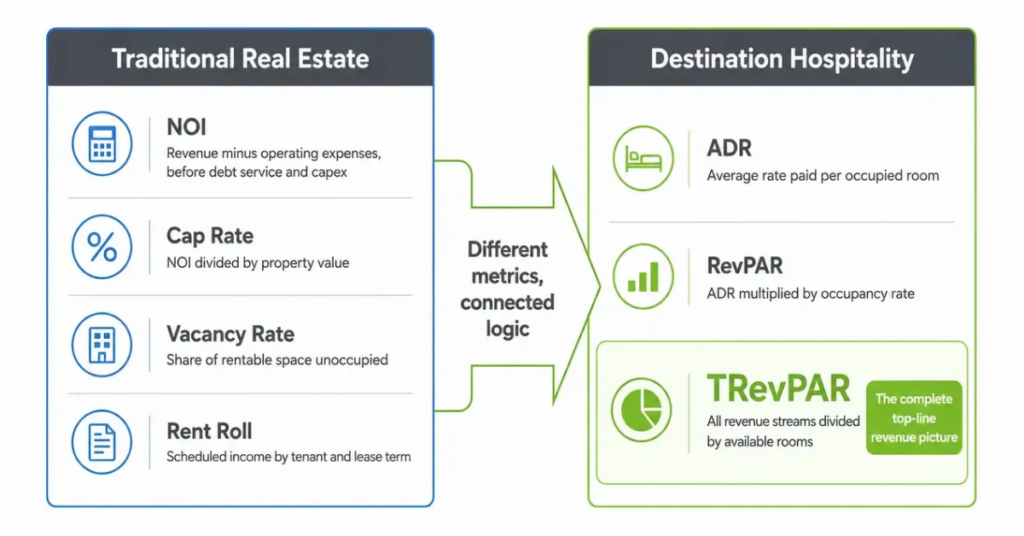
Traditional real estate and destination hospitality use different operating metrics — understanding how they connect is how investors bridge the two frameworks
How to Apply This Framework When Evaluating an Opportunity
For an investor with a traditional real estate background approaching destination hospitality for the first time, the evaluation process has a few additional layers beyond what you are used to.
Start with the revenue composition. Ask for a breakdown of revenue by stream and understand what percentage is contractually committed in advance through event bookings. A strong forward event calendar reduces income uncertainty in a way that is directly comparable to a strong rent roll — and should be evaluated with similar rigor.
Then look at the stress performance record. How did this property and operator perform during periods of disruption? Unlike multifamily, where vacancy data tells a relatively clean story, destination asset resilience shows up in operational decisions — how the team responded when conditions shifted, whether contracted event revenue held, whether the business found ways to generate income when primary channels were constrained. Ask for specific history, not general assurances.
Finally, evaluate the operator with the same seriousness you would apply to the financial model. In destination hospitality, operator quality is not a soft factor — it is a primary driver of whether the multi-stream revenue model is realized. Review track record across all relevant operating categories, not just lodging. If the opportunity allows for a property visit during peak operations, take it. What you observe about guest volume, event execution, and the quality of the experience tells you things about operator capability that no document can.
For accredited investors who want to go deeper on destination hospitality real estate as an asset class, the investor resource library at accountableequity.com provides additional material on fund structure, due diligence, and the investment thesis for experiential real estate.
Frequently Asked Questions
How do returns in destination hospitality compare to multifamily?
Direct comparisons are difficult because return structures differ. Multifamily syndications typically target returns through cash flow distributions and appreciation at disposition. Destination hospitality funds are generally structured similarly at the fund level, but the drivers — multi-stream operating income, event revenue, and asset appreciation tied to operational improvement — are different. Any stated return in a specific offering should be evaluated alongside the assumptions underlying it. No return in any real estate investment is guaranteed. Consult a qualified financial advisor before making any investment decision.
How liquid is a destination hospitality fund investment compared to owning multifamily?
Private real estate fund investments, including destination hospitality funds, are generally illiquid by design. Unlike direct multifamily ownership — where you can sell the asset — or a public REIT — where shares trade daily — a private fund investment typically has a defined hold period and limited redemption options before the fund reaches a liquidity event. Investors should treat this as long-term capital and should not commit funds they may need access to in the near term. Liquidity terms vary by fund and should be reviewed carefully in the offering documents.
What does due diligence look like for a destination hospitality investment versus multifamily?
The fundamentals are similar: review the sponsor track record, understand the capital structure, examine the financial projections and the assumptions behind them, and assess the market. The additional layer in destination hospitality is operational due diligence — evaluating the sponsor’s depth across all the revenue categories the property depends on, not just their ability to manage a lodging asset. Reviewing historical TRevPAR data, the forward event booking calendar, and the operator’s response to past disruptions gives you a more complete picture than financial statements alone. A property visit during peak operations, where practical, provides a level of insight into operator quality that documents cannot replicate.
Conclusion
Destination assets perform differently from traditional real estate because they are built differently. The multi-stream revenue model, the contractual event booking structure, and the centrality of operator quality all create a performance profile that rewards investors who understand the specific conditions driving it — and penalizes those who apply a conventional real estate lens without adjustment.
For investors coming from multifamily or other traditional categories, the analytical foundation you already have is the right starting point. NOI still matters. The quality of contracted forward revenue still matters. Operator track record still matters. What changes is the framework for measuring those things at the property level — and that is what ADR, RevPAR, and TRevPAR are designed to provide.
The investors who evaluate destination hospitality well are not those who abandon what they know. They are the ones who extend it.