

Family offices don’t invest in asset classes because they’re interesting. They allocate when an asset clears their underwriting threshold — predictable revenue, defensible returns, low correlation to public markets, and an operator they can verify. Experiential real estate is clearing that threshold, and the reasons are structural rather than aspirational.
According to The Wealth Report 2025 (Knight Frank, based on interviews with 150 global family offices conducted November–December 2024), direct real estate already accounts for 22.5% of the typical family office portfolio — and more than four in 10 surveyed intend to increase that allocation over the next 18 months. The biggest single barrier to doing so? Difficulty identifying reliable partners or operators, cited by 23% of respondents. That data point matters for how this asset class should be read: the demand is there; the constraint is operator quality, not capital appetite.
The Campden Wealth / RBC North America Family Office Report 2024 (183 North American family offices surveyed March–June 2024) tells a complementary story: private market investments now account for 30% of the average North American family office portfolio — continuing a multi-year trend in which private markets have become the largest-held asset class for North American family offices, surpassing public equities. Notably, conventional commercial real estate has posed challenges in this environment due to oversupply and rising interest rates. That context is relevant: family offices moving toward private real assets are not moving toward conventional commercial real estate. They are moving toward assets with differentiated revenue models — which is precisely where destination hospitality sits.

The outdoor dining terrace at Taste 1864, Renault Winery Resort, Egg Harbor City, NJ — one of 19 unique venues on the property. Pictured are Josh McCallen and Melanie McCallen, who co-founded both Accountable Equity and Vivamee Hospitality. Josh serves as CEO of both entities; Melanie serves as Chief Experience Officer of Vivamee Hospitality. Assets held by funds offered by Accountable Equity; operated by Vivamee Hospitality. Investment opportunities are available exclusively to verified accredited investors.
What “Experiential” Means When You’re Underwriting It
The word gets used loosely. For investment purposes, an experiential asset is a property whose revenue model is driven by active guest participation across multiple categories — lodging, events, food and beverage, recreation, retail — rather than by a single income stream. The investment case is not “people like experiences.” It is that multi-stream revenue assets have a fundamentally different risk and return profile from single-use properties, and the operational complexity required to execute that model is a barrier most investors and operators cannot clear.
That barrier is the investment thesis.
The demand-side data supports the structural case. According to Deloitte’s 2024 Holiday Retail Survey, consumers surveyed had favored experiences over goods for the prior 18 months, with experience spending expected to increase 16% year-over-year in the 2024 holiday season. A separate Deloitte Insights analysis of U.S. consumer spending supports the longer-term picture: since Q2 2021, services have been the primary driver of U.S. consumer spending, while durable goods spending declined. Destination hospitality — weddings, resort stays, golf, events — sits squarely within the services and experiences categories capturing an increasing share of consumer wallet. Sources: Deloitte 2024 Holiday Retail Survey (deloitte.com/us/en/insights); Deloitte Insights, “Consumer spending on services,” deloitte.com/us/en/insights.
What the Revenue Model Actually Looks Like
The most important distinction between destination hospitality and conventional hotel investing is the contractual revenue layer.
Weddings, corporate retreats, and recurring private events book 12 to 18 months in advance. They are not subject to the same cancellation dynamics as transient leisure travel. When consumer confidence softens or stock markets correct, a bride does not cancel her wedding. When a corporate client books a two-day leadership retreat 14 months out, that revenue is contracted before the macro environment that will exist on the event date is even knowable. This forward-booking structure creates a revenue visibility window that multifamily, conventional hotels, and most commercial asset classes cannot replicate.
Renault Winery Resort — a destination asset held by funds offered by Accountable Equity and operated by Vivamee Hospitality — has 19 unique venues on property and the operational capacity to run up to 13 separate events across a single Thursday–Sunday peak window. That is 13 concurrent contracted commitments — each with its own staffing, logistics, catering, setup, and guest experience execution — happening simultaneously on the same grounds. The systems required to execute that reliably are not learnable from a real estate underwriting model. They are built through years of actual event operations.
The appropriate performance metric for a property like this is not RevPAR — revenue per available room — which measures only lodging. It is TRevPAR: total revenue per available room. When a property captures revenue across rooms, multiple food and beverage outlets, event spaces, golf, vineyard and wine experiences, retail, and recreational amenities, a room-centric metric misrepresents the actual economics of the investment. Sophisticated investors who push operators on this distinction are asking the right question. Operators who can’t answer it are not operating the model they’re selling.
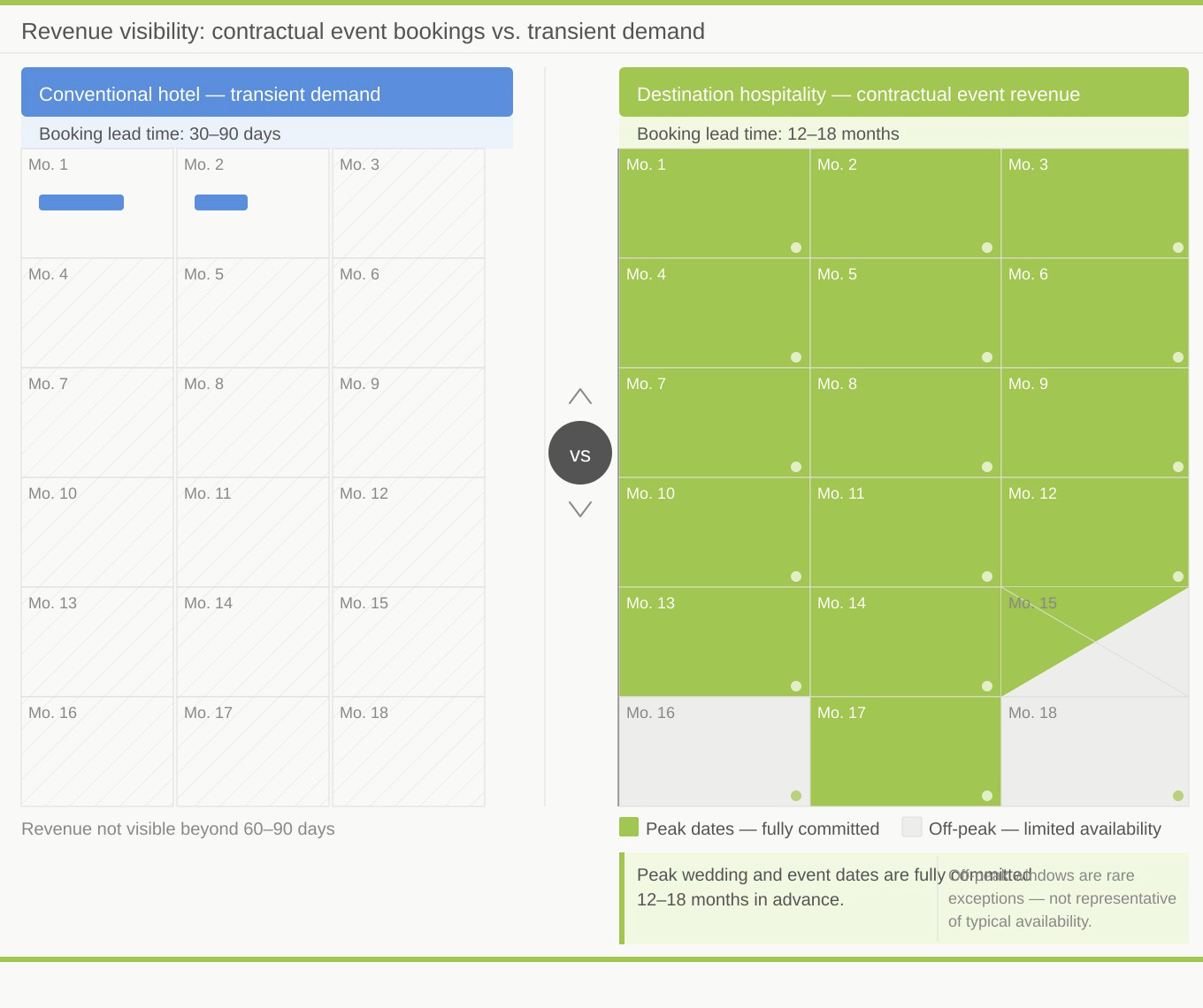
Destination hospitality properties with robust contractual event calendars generate forward-booked revenue 12–18 months before the operating period opens — a revenue visibility window that transient demand models cannot replicate. Assets held by funds offered by Accountable Equity; operated by Vivamee Hospitality.
The Stress Test: 2020
The theoretical case for contractual revenue is straightforward. The more useful question is what it looked like under the most adverse conditions the asset class has faced in recent memory.
When the pandemic shutdowns of 2020 took effect, Renault Winery Resort had just completed a major renovation and was in early operation. The Vivamee team, led by Josh McCallen and Melanie McCallen, co-founders of both Accountable Equity and Vivamee Hospitality, made a different choice than most hospitality operators. Rather than closing and waiting, they adapted operationally. An outdoor dining concept adjacent to the property’s restaurant was physically reconfigured to meet new health regulations and reopened while indoor dining remained prohibited. The property stayed open throughout the shutdowns.
On the contracted revenue side: booked weddings were rescheduled rather than cancelled. To the best of available information, no contracted bookings were lost to the shutdown period. When Independence Day fireworks were cancelled up and down the Jersey Shore, the team sourced a private fireworks show over the golf course — drawing guests, investors, and the public to the property while comparable venues sat dark.
This is not a resilience anecdote. It is operational evidence that the team running this model has demonstrated the capacity to protect contracted revenue and create new revenue channels under genuine stress. For investors evaluating operators on what they do when conditions turn adverse, this is the relevant data point.

Aerial view of Renault Winery Resort in Egg Harbor City, NJ during peak seasonal operations, showing simultaneous activation of resort hotel, event tents, dining areas, and golf course — a destination hospitality asset held by funds offered by Accountable Equity and operated by Vivamee Hospitality.
Why Operator Selection Is the Entire Underwriting Question
The theoretical case for experiential assets depends entirely on the quality of the operator executing it. Recall the Knight Frank finding: the #1 barrier to increased family office real estate allocation is difficulty identifying reliable partners or operators. A destination hospitality asset with weak management is not defensible — it is just expensive and complicated. The complexity moat only works if the operator can clear it.
According to company biography, Josh McCallen brings 25+ years of hospitality experience, including serving as President and Partner of ICONA Resorts, where the company achieved Inc. 5000 recognition three consecutive years and was ranked the #7 hotel in the United States by TripAdvisor (ICONA Diamond Beach, 2017). Today he serves as CEO of both Accountable Equity and Vivamee Hospitality, the entities he co-founded with Melanie McCallen to apply that operating model at scale across a growing portfolio of destination assets. Melanie serves as Chief Experience Officer of Vivamee Hospitality and brings 25+ years of independent hospitality experience to the role, as reported by the company. Her function addresses one of the most consequential risks in distressed hospitality acquisition: misreading what a property can authentically become and improving it in the wrong direction. The ability to walk a distressed asset and identify its genuine potential — rather than imposing an external vision — is not a generalist operator skill, and it is not replicable by a hired management company.
Both Accountable Equity and Vivamee Hospitality achieved Inc. 5000 recognition in 2025 — a dual listing in the same calendar year. For investors who evaluate platforms rather than individual deals, that signal is meaningful: it indicates the capital formation and operating sides of the business are scaling simultaneously, not one at the expense of the other.
The current portfolio — Renault Winery Resort (Egg Harbor City, NJ), Kent Island Resort (Chester, MD), LBI National Golf & Resort (Little Egg Harbor, NJ), and Bohemia Manor Farm (Maryland) — represents four distinct asset types across two states, all operating under the Vivamee system. The documented growth target is 25 resorts by 2035. For accredited investors evaluating a platform rather than a single deal, that trajectory is part of the underwriting conversation.
According to Accountable Equity, the Vivamee portfolio hosts 320,000+ guests annually across properties totaling more than 1,000 acres and 2.5 miles of waterfront, and 465+ accredited investor families currently participate in funds offered by Accountable Equity. These figures are company-reported and have not been independently verified by third parties. They indicate the scale of throughput this team manages every year — and the operational depth that creates the barrier to entry the thesis depends on.
Frequently Asked Questions
What makes experiential assets structurally different from conventional hospitality investments like hotels?
The revenue model is the primary distinction. Conventional hotels rely heavily on transient nightly demand — ADR and occupancy rates that rise and fall with leisure travel patterns. A destination hospitality asset with a robust contractual event business generates forward-booked revenue that is largely independent of short-term demand fluctuations. The appropriate metric is TRevPAR, not RevPAR, because it captures the full revenue model across lodging, events, food and beverage, golf, and recreational amenities. Investors who underwrite only on RevPAR are measuring a fraction of the business.
How should a family office evaluate the operator when assessing an experiential asset?
The same criteria that apply to any sponsor evaluation apply here — with added weight on operational track record specific to this asset class. Hospitality staffing scale, event execution track record, property transformation history, contractual revenue as a percentage of total revenue, and performance data from a downside period are all relevant inputs. An operator who can produce TRevPAR data across multiple properties and multiple years is providing a more complete picture than one who presents occupancy rates alone. The Knight Frank data is instructive: 23% of family offices cite operator identification as their primary barrier to increased real estate allocation. Due diligence on operator quality is not a box to check — it is the decision. Investment opportunities offered by Accountable Equity are available only to independently verified accredited investors under Rule 506(c) of Regulation D.
What is the growth trajectory argument for platforms in this space?
For family offices evaluating a platform rather than a single asset, growth trajectory matters. An operator with a documented path to scale — backed by operational proof across multiple asset types — represents a different allocation decision from a boutique manager with one or two properties. The 25-resort-by-2035 target is not a marketing figure; it is an institutional signal about how the operating and capital formation platforms are designed to scale.
The Argument in Brief
Family offices are moving into experiential assets because the structural investment case — contractual revenue visibility, multi-stream economics, operational complexity as a moat, non-correlation to conventional commercial real estate — holds up under professional underwriting. The Wealth Report 2025 shows more than four in 10 family offices intending to increase real estate allocation; the Campden data shows private markets continuing to outpace public equities as the largest-held asset class. Neither trend points toward conventional commercial real estate. Both point toward operationally differentiated real assets with defensible revenue models.
The operator selection question, which is the entire decision, comes down to whether the team managing the asset has demonstrated the execution depth the model requires. For individual accredited investors asking why institutional capital is here, the answer is not complicated. Sophisticated allocators are not in this category because it’s interesting. They’re here because the numbers work — when the operator does. Investors considering this asset class should consult a CPA familiar with real estate syndications and a securities attorney experienced in private placements before making any investment decision.