

A preferred return in a private real estate fund is a minimum return threshold that limited partners (LPs) must receive before the general partner (GP) participates in profits. It is the mechanism by which fund structures prioritize investor capital — and it is one of the clearest signals you have of how a sponsor thinks about alignment with the people investing alongside them.
If you have invested in multifamily syndications or self-storage deals, you have almost certainly seen a preferred return — often listed as an 8% preferred return or 8% pref in the deal summary. But understanding what that number actually means, how it compounds, and what its presence (or absence) tells you about a sponsor’s incentive structure is a different level of analysis than simply noting it exists.
Investment opportunities offered by Accountable Equity are available only to verified accredited investors through offerings made in accordance with Rule 506(c) under Regulation D.
Accredited investor status requires verification prior to participation — not self-certification. If you are unsure whether you qualify, consult with a qualified securities attorney.
The Basic Mechanics: What a Preferred Return Actually Means
The preferred return — sometimes called the “pref” — is a priority claim on fund distributions. Before the GP takes any profit share (known as carried interest or the “carry”), LPs must receive distributions equal to their preferred return rate, applied to their invested capital.
Here is how that works in practice:
- An LP invests $100,000 in a fund with an 8% preferred return.
- In year one, the fund generates sufficient cash flow for distributions.
- The LP receives $8,000 in distributions (8% × $100,000) before the GP earns any carried interest.
- Only after LPs have received their full preferred return does the GP begin participating in profits above that threshold.
This structure matters because it determines whose interests come first when cash is available for distribution. A GP who earns nothing until investors receive their preferred return has a fundamentally different incentive structure than one who takes fees and promoted interest regardless of investor performance.
Cumulative vs. Non-Cumulative: A Distinction That Matters
Not all preferred returns are equal. Two funds can both advertise an 8% preferred return and deliver materially different experiences for investors, depending on whether that pref is cumulative or non-cumulative.
Cumulative Preferred Return
If a fund does not fully distribute the preferred return in a given period — whether due to operating reserves being maintained for business health, capital being held for portfolio positioning, reinvestment decisions, or any other reason — a cumulative structure carries the shortfall forward. The LP is owed the missed distribution in future periods, and the GP still cannot participate in profits until the full accumulated preferred return has been paid to LPs.
Non-Cumulative Preferred Return
A non-cumulative structure does not carry forward missed distributions. If the fund falls short in year two, that missed distribution does not accrue. The GP can begin participating in profits in year three without first making up the year-two shortfall.
The distinction is not always clearly labeled in deal summaries. When evaluating a fund, ask specifically: “Is this preferred return cumulative? What happens if distributions fall short in a given year?” The answer tells you more about sponsor intent than the preferred return rate itself.
How a Preferred Return Actually Works
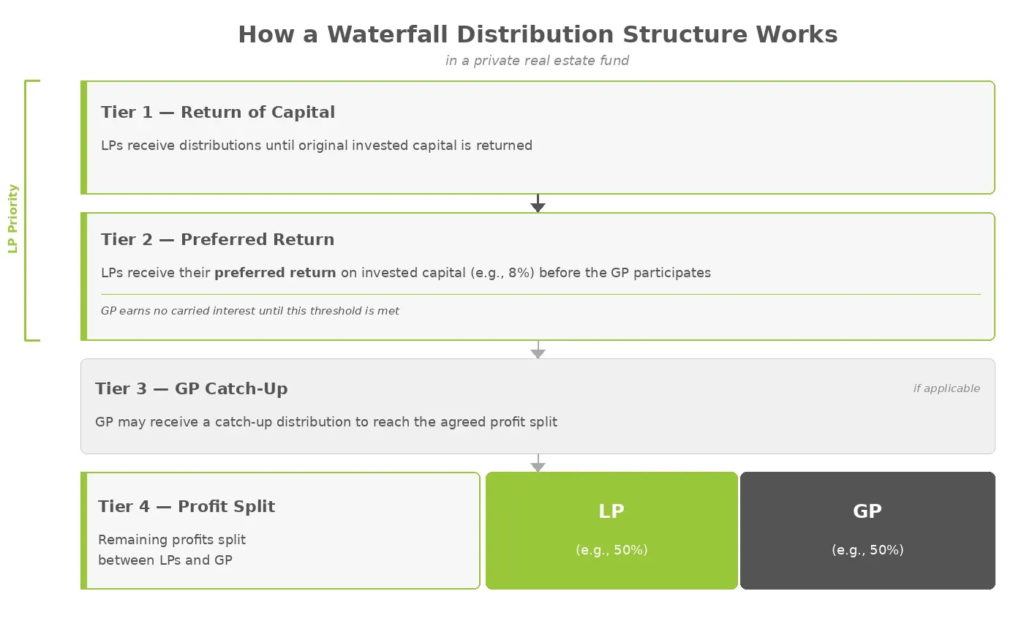
In a typical waterfall structure, limited partners receive their preferred return before the general partner participates in profits. Diagram for illustrative purposes only.
The preferred return sits within a broader distribution waterfall — the sequence in which a fund distributes available cash. A typical two-tier waterfall in a private real estate fund works as follows:
- Tier 1 — Return of Capital: LPs receive distributions until their original invested capital is returned.
- Tier 2 — Preferred Return: LPs receive their preferred return on invested capital, calculated for the period capital was deployed.
- Tier 3 — GP Catch-Up (if applicable): Some structures allow the GP to “catch up” to a negotiated percentage of total profits, bringing their carried interest share to the agreed split.
- Tier 4 — Profit Split: Remaining profits are split between LPs and the GP at the agreed carried interest percentage — commonly 70/30 or 80/20 in favor of LPs.
Not every fund uses all four tiers. Some funds skip the GP catch-up entirely; others apply the preferred return only to net cash flow rather than to all capital returned. Reading the operating agreement — not just the deal summary — is the only way to know which version you are looking at.
What the Preferred Return Tells You About Sponsor Alignment
The preferred return rate is a data point. The structure surrounding it is the signal.
A sponsor who offers a cumulative preferred return with no GP catch-up, structured as a meaningful hurdle before carried interest, has designed the economics to align their outcome with investor outcome. A sponsor who offers a non-cumulative preferred return with a generous GP catch-up and a fee structure that generates income regardless of performance has designed the economics differently.
Questions worth asking when evaluating any fund:
- Is the preferred return cumulative or non-cumulative?
- What is the GP catch-up structure, if any?
- Does the preferred return apply to total invested capital, or only to deployed capital?
- What fees does the GP collect regardless of investor distributions — acquisition fees, asset management fees, disposition fees?
- How does the GP’s economic interest change if the fund underperforms the preferred return?
These questions are related to the broader sponsor evaluation framework covered in questions to ask before investing in a real estate fund. The preferred return is one piece of a larger picture.
The Connection Between Revenue Model and Preferred Return Coverage
A preferred return is only as strong as the fund’s ability to generate the cash flow to pay it. This is where asset class and operating model matter.
A fund invested in destination hospitality assets — resort properties with contracted event revenue from weddings, corporate retreats, and membership programs — has a different profile for preferred return coverage than a fund invested in assets that depend entirely on nightly rates or occupancy.
Contractual event revenue books 12 to 18 months in advance. Wedding contracts, in particular, have historically shown strong persistence through economic disruptions — events reschedule rather than cancel, and the revenue commitment is made far ahead of the distribution period. That revenue stability directly supports a fund’s capacity to cover its preferred return obligations to investors.
Funds offered by Accountable Equity are structured around this revenue model. The funds own resort assets operated by Vivamee Hospitality — co-founded by Josh McCallen and Melanie McCallen — across properties including Renault Winery Resort, Kent Island Resort, LBI National Golf & Resort, and Bohemia Manor Farm. Vivamee’s operating model, developed over Josh McCallen’s 25+ years of hospitality experience and Melanie McCallen’s independent 25+ years of hospitality leadership, generates revenue across multiple streams — lodging, events, dining, memberships — which supports distribution capacity beyond what single-revenue-stream hospitality assets can offer.
This is not an argument that any specific distribution is guaranteed. It is not. Return language requires qualifiers for a reason: no return is guaranteed, and real estate syndication investments involve risk, including the potential loss of principal. The point is that the asset class and operating structure behind a fund are material to how realistic any preferred return target is — and evaluating that context is part of serious sponsor due diligence.

Bohemia Manor Farm, Chesapeake City, MD — an asset owned by the funds offered by Accountable Equity and operated by Vivamee Hospitality. Investment opportunities are available to verified accredited investors only.
FREQUENTLY ASKED QUESTIONS
What is a typical preferred return rate in a private real estate fund?
Preferred return rates in private real estate funds commonly range from 6% to 10% annually, with 7% to 8% being among the more frequently cited targets in current market conditions. The rate alone does not determine value — whether the pref is cumulative, how it interacts with the GP catch-up, and the fund’s underlying revenue model all affect what the rate actually means in practice. Each investor should review the fund’s full offering documents and consult with a qualified professional before concluding the rate alone.
Is a preferred return the same as a guaranteed return?
No. A preferred return is a priority structure — it sets the order in which distributions are made, not the certainty that they will be made. If a fund does not generate sufficient cash flow or proceeds to cover the preferred return, LPs may not receive it. Real estate syndication investments involve risk, including the potential loss of principal. Any communication framing a preferred return as guaranteed or certain should be a red flag in sponsor evaluation.
Does a higher preferred return always mean a better deal for investors?
Not necessarily. A higher preferred return rate can be offset by a more aggressive GP catch-up structure, higher fees, or a non-cumulative structure that allows the GP to begin earning carry even after years when the preferred return was not fully paid. Evaluating the full waterfall structure, the fee schedule, and the sponsor’s track record gives a more complete picture than the preferred return rate in isolation.
What happens if a fund cannot meet the preferred return in a given year?
The answer depends on whether the preferred return is cumulative or non-cumulative. In a cumulative structure, the shortfall is carried forward, and the GP cannot participate in profits until the full accrued preferred return has been paid to LPs. In a non-cumulative structure, the shortfall is not carried forward — it is simply not paid. This is a material structural difference and worth confirming explicitly before investing. Consult with a CPA familiar with real estate syndications or a securities attorney to understand how any specific fund’s structure applies to your situation.
How does the preferred return connect to the GP/LP structure in a real estate fund?
The preferred return is one element of the GP/LP structure — the framework that defines how profits and losses are allocated between the general partner (the operator or sponsor) and the limited partners (the investors). The GP manages the fund and the assets; the LPs provide capital and receive returns based on the waterfall structure. Understanding the full GP/LP structure — not just the preferred return — is essential to evaluating any private real estate fund.
The Preferred Return Is a Starting Point, Not the Full Picture
A preferred return tells you that a fund has built in a priority for LP distributions. What it does not tell you — without further analysis — is whether that priority is cumulative, how it interacts with the GP catch-up, what fees exist outside the waterfall, and whether the underlying assets generate sufficient cash flow to make the preferred return coverage realistic.
Experienced investors in private real estate funds treat the preferred return as one data point in a larger evaluation. The questions it prompts — about structure, about fees, about operator track record, about revenue model — are often more revealing than the rate itself.
If you are evaluating private real estate funds and want to understand how Accountable Equity structures its offerings for verified accredited investors, explore the Accountable Equity investor resources or reach out to start a conversation.