

Real estate syndication fees are the payments a sponsor (the general partner) earns for sourcing, managing, and eventually selling a deal on behalf of its investors (the limited partners). Across the industry, the most common fees are an acquisition fee, an annual asset management fee, a disposition fee at sale, and a profit share known as the promote or carried interest — typically paid only after investors receive a preferred return. Understanding these fees is the single most useful skill an investor can bring to evaluating a syndication, because fee structure does more than determine cost. It reveals how a sponsor gets paid relative to your outcome, and whether their incentives are aligned with yours. This guide breaks down each fee category, explains what it actually pays for, and shows how to read a fee structure as a signal of alignment. By the end, you will be able to look at any offering and ask sharper questions about who profits, when, and why.
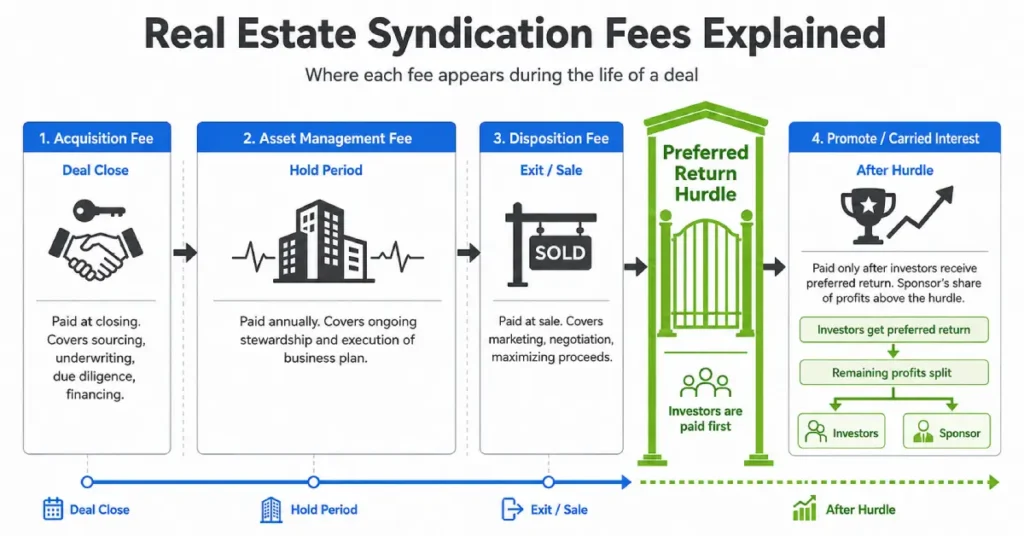
The core fee categories in a real estate syndication and where each one sits in the deal lifecycle.
Accountable Equity offers investment opportunities exclusively to verified accredited investors under Rule 506(c) of Regulation D. All investors must meet applicable qualification requirements as defined by the SEC. For a detailed overview of who qualifies as an accredited investor, visit our accredited investor resource page.
In This Article
• Real Estate Syndication Fees Explained: The Core Categories
• Real Estate Syndication Fees Explained: Acquisition and Disposition Fees
• Asset Management Fees: Paying for Ongoing Stewardship
• The Promote and Preferred Return: Where Alignment Lives
• Frequently Asked Questions
Real Estate Syndication Fees Explained: The Core Categories
A real estate syndication pools capital from many accredited investors to buy and operate a property that no single investor would purchase alone. The sponsor does the work — finding the deal, raising the capital, executing the business plan, and managing the asset — and the fees are how the sponsor is compensated for that work. Fees are not inherently good or bad. They are the price of professional management, and the right question is never “are there fees?” but “what do these fees pay for, and how are they structured?”
Most syndications use some combination of the same five fee categories. There is an acquisition fee paid when the deal closes, an asset management fee paid annually during the hold, a disposition fee paid when the property sells, a preferred return that protects investor capital, and a promote (also called carried interest) that gives the sponsor a share of the profits. Each one sits at a different point in the deal lifecycle, and each one sends a different signal about how the sponsor expects to make money.
The reason real estate syndication fees explained well matter so much is that they determine the order of who gets paid. A structure that pays the sponsor mostly through transaction fees rewards activity — buying and selling. A structure that pays the sponsor mostly through the promote rewards results — actual investor profit. Reading that difference is the heart of evaluating any offering, and it applies whether the underlying asset is multifamily, self-storage, industrial, or destination hospitality.
Real Estate Syndication Fees Explained: Acquisition and Disposition Fees
Acquisition and disposition fees compensate the sponsor for the transaction work at the two ends of a deal: buying the property and selling it. Across the industry, an acquisition fee is commonly expressed as a percentage of the purchase price and is paid at closing. A disposition fee, when charged, is expressed as a percentage of the sale price and is paid when the property is sold. Both are transaction-based, meaning the sponsor earns them whether or not the investment ultimately performs.
What the acquisition fee pays for
The acquisition fee covers the substantial, mostly unpaid work that happens before a single dollar is invested: sourcing deals, underwriting dozens of properties for every one that closes, conducting due diligence, negotiating purchase terms, securing financing, and managing the closing. For every property a disciplined sponsor buys, it may have analyzed and rejected many others. The acquisition fee funds that pipeline. The relevant question for an investor is whether the fee is reasonable relative to the work and the deal size — an outsized acquisition fee can incentivize a sponsor to transact for the sake of transacting.
What the disposition fee pays for
A disposition fee compensates the sponsor for managing the sale process — preparing the asset, engaging brokers, marketing, and negotiating the exit to maximize proceeds. Not every sponsor charges one. When it appears, an investor should look at whether it is modest and whether it sits behind the investor preferred return in the waterfall, so the sponsor is not paid to sell at a price that fails to reward investors first.
Asset Management Fees: Paying for Ongoing Stewardship
The asset management fee compensates the sponsor for the ongoing stewardship of the investment during the hold period. Across the industry it is typically charged annually, often as a percentage of invested capital, assets under management, or collected revenue. This is the fee that pays the sponsor to actually run the business plan after the deal closes — not to be confused with property management, which is the day-to-day operation of the physical asset and is usually a separate function.
The distinction matters most in operationally intensive asset classes. A passive net-lease building requires little ongoing management. A destination resort — with rooms, dining, events, golf, and seasonal staffing — requires constant, sophisticated oversight. This is where vertical integration becomes relevant: when the same team that owns the asset also operates it, the asset management function and the operating function are aligned rather than outsourced to a disinterested third party. At Accountable Equity, the funds offered own the resort assets and VIVÂMEE Hospitality operates them, with Josh McCallen serving as Co-Founder and CEO and Melanie McCallen as Co-Founder and Chief Experience Officer of VIVÂMEE. That structure is one way an asset management fee can map directly to genuine operating accountability rather than a layer of passive supervision.
For investors, the asset management fee is best read alongside the work it funds. A reasonable, transparent fee paying for a capable, accountable operator is value. The warning sign is an asset management fee that grows regardless of performance, or one charged on top of multiple other layers without a clear explanation of what each layer does. You can review how Accountable Equity structures its offerings, and compare that framework against any sponsor you evaluate.
The Promote and Preferred Return: Where Alignment Lives
The promote — also called carried interest — is the sponsor’s share of the profits, and it is the single most important fee for understanding alignment. Unlike the transaction and management fees above, the promote is a performance fee: the sponsor earns it only after investors have been paid back according to the agreed structure. A typical arrangement gives the sponsor a share of profits above a defined hurdle, which means the sponsor makes its most meaningful money only when investors make money. That is alignment by design.
How the preferred return hurdle works
The preferred return is the minimum annual return that limited partners receive before the sponsor shares in any profits. Across private real estate, preferred returns commonly range from roughly 6% to 8% annually, though the exact figure varies by deal and sponsor and is never assured or promised. The preferred return functions as a hurdle: profits first flow to investors until they have received their preferred return (and often their capital back), and only then does the sponsor begin to collect its promote. The higher and more investor-protective the hurdle, the more the sponsor must deliver before it profits.
Reading the waterfall
The sequence in which cash is distributed is called the waterfall. A common structure returns the preferred return to investors first, then splits remaining profits between investors and the sponsor — sometimes with additional tiers that increase the sponsor’s share as returns climb higher. The waterfall is where you see, in concrete terms, who gets paid in what order. A structure that puts investor capital and the preferred return ahead of the promote is one in which the sponsor is paid to perform, not merely to participate.

LBI National Golf & Resort, Little Egg Harbor, NJ — owned by the funds offered by Accountable Equity and operated by VIVÂMEE Hospitality.
What a fee structure reveals about sponsor alignment
Once you can name each fee, you can read a fee structure as a map of the sponsor’s incentives. The central question is simple: does the sponsor make most of its money from transacting and managing, or from delivering profit to investors? A structure weighted toward transaction fees rewards motion — buying, selling, and refinancing — regardless of outcome. A structure weighted toward the promote, sitting behind a real preferred return, rewards the outcome investors actually care about.
This is also where the operator behind the fees matters. A reasonable promote means little if the sponsor cannot execute. Investors evaluating any offering should weigh the fee structure together with the sponsor’s track record, the depth of its operating team, and whether the same people who raise the capital are accountable for the results. A higher barrier to entry in a specialized asset class can mean fewer capable operators and less commoditized competition, which is part of why operating expertise deserves as much scrutiny as the fee schedule itself.
None of this requires memorizing a single “right” fee level, because fee terms vary widely across the industry and no figure should be read as a benchmark on its own. What it requires is understanding what each fee pays for and where it sits in the waterfall. The investor who can do that holds a decisive advantage in evaluating deals — they can tell the difference between a fee that funds genuine value and a fee that simply transfers it.
Frequently Asked Questions
What are typical real estate syndication fees?
Typical real estate syndication fees include an acquisition fee paid at closing, an annual asset management fee during the hold, a disposition fee at sale, and a promote (carried interest) paid to the sponsor after investors receive a preferred return. The exact percentages vary widely by sponsor, asset class, and deal structure, so they should always be reviewed in the specific offering documents rather than assumed from an industry average.
What is the difference between the preferred return and the promote?
The preferred return is the minimum annual return investors receive before the sponsor shares in profits; the promote is the sponsor’s share of profits earned only after that hurdle is met. In practice, cash flows to investors first up to the preferred return, then the sponsor begins collecting its promote on profits above the hurdle. This ordering is what aligns the sponsor’s upside with investor performance.
How do syndication fees affect investor returns?
Fees reduce gross returns, but the more important effect is structural: fees weighted toward transactions pay the sponsor regardless of performance, while fees weighted toward the promote pay the sponsor only when investors profit. Two deals with similar headline returns can have very different alignment depending on how the fees are arranged in the waterfall. Reading the structure, not just the percentages, is what tells you whether incentives are aligned.
Putting Fee Knowledge to Work
Fee structure is the most misunderstood element of syndication investing, and it is also the most revealing. Acquisition and disposition fees pay for transaction work, the asset management fee pays for ongoing stewardship, and the promote behind a preferred return is where sponsor incentives either align with yours or do not. The investor who understands what each fee pays for — and reads the waterfall to see who gets paid when — can evaluate any deal with far more confidence. To go deeper on how these structures work in practice, explore our investor resources and continue the conversation about evaluating sponsors and offerings.
Up Next in This Series
Next: How Airline Pilots Build Passive Income Through Real Estate Syndication