
Experiential destination hospitality (resorts, winery estates, golf properties, and event-driven venues) is outperforming traditional hotel investments because it generates revenue from multiple streams simultaneously, not just room nights. Most investors dismiss the asset class as “too complex.” For qualified operators, that complexity is the point. It creates some of the highest barriers to entry and most defensible revenue models in all of real estate.
This article explains why the experiential hospitality thesis works for investors, how to evaluate revenue beyond conventional hotel metrics, and what separates qualified operators from generalists in this space.

An event set in the vineyards at Bohemia Manor Farm, Chesapeake City, MD. Experiential hospitality properties generate revenue across events, dining, and curated guest experiences. Owned by the funds offered by Accountable Equity and operated by VIVÂMEE Hospitality.
| Investment opportunities discussed in this article are available only to independently verified accredited investors as defined by applicable securities laws, including individuals meeting income thresholds of $200,000 (individual) or $300,000 (joint) for each of the two most recent calendar years with reasonable expectation of the same in the current year, or a net worth exceeding $1,000,000 excluding primary residence. All investments involve risk, including the potential loss of principal. This content is educational and does not constitute an offer to sell securities. |
In This Article
• Why Traditional Hotel Metrics Miss the Full Picture
• The Revenue Diversification Advantage
• The Metric That Matters: TRevPAR
• Contracted Event Revenue: The Downside Protection Layer
• What Separates Qualified Hospitality Operators
Why Traditional Hotel Metrics Miss the Full Picture
The hospitality industry evaluates performance primarily through two metrics: ADR (average daily rate) and RevPAR (revenue per available room). Both measure room revenue, meaning what a hotel earns from selling guest rooms. For a traditional limited-service or full-service hotel, these metrics capture the majority of revenue because rooms are the primary revenue driver.
For experiential destination properties, rooms may represent only a fraction of total revenue. A winery resort generates revenue from vineyard tours, winemaking experiences, dining, weddings and events, golf, spa services, and lodging. A golf resort earns from memberships, public play, catering, corporate events, and rooms. A waterfront estate produces revenue from destination weddings, private events, wine tourism, and boutique hospitality.
When investors evaluate these properties using ADR and RevPAR alone, they systematically understate the revenue model. This isn’t a minor measurement gap. It’s a structural blind spot that causes many investors to dismiss experiential hospitality assets as underperforming when they are, in fact, generating significantly more total revenue per available room than their traditional hotel counterparts.
The Revenue Diversification Advantage
Revenue diversification is the investment thesis in experiential hospitality. Multiple independent revenue streams reduce dependence on any single demand driver and create resilience that single-stream assets can’t match.
Leisure Travel + Events + Dining + Activities
A destination resort generates revenue from guests who stay overnight, guests who visit for events, guests who dine without staying, and guests who participate in activities like golf, wine tasting, or spa services. These revenue streams have different demand drivers, different seasonality patterns, and different sensitivity to economic cycles. When leisure travel softens, contracted event revenue holds. When midweek occupancy is lower, golf memberships and dining revenue continue.
Forward Booking Visibility
Weddings and corporate events book 12 to 18 months in advance. That forward booking window creates revenue visibility that traditional hotels, which depend on nightly bookings, simply can’t match. A property with 250 weddings booked for the coming year has a substantial portion of its revenue already contracted before the calendar turns. That visibility is valuable for the operator’s planning and equally valuable for investors evaluating the stability of the revenue model.
The Metric That Matters: TRevPAR
TRevPAR, or total revenue per available room, captures the full revenue picture. It divides all property revenue (rooms, food and beverage, events, activities, memberships, and ancillary sources) by the number of available rooms. For a traditional hotel, TRevPAR and RevPAR may be relatively close. For an experiential destination property, TRevPAR can be multiples of RevPAR because the non-room revenue streams are so substantial.
Investors evaluating experiential hospitality assets should ask for TRevPAR, not just ADR and RevPAR. A property with moderate ADR but high TRevPAR is generating strong total revenue per room, which is the metric that actually drives investment returns. A property with high ADR but similar TRevPAR to a traditional hotel is not leveraging the experiential model effectively.
Here’s the simplest way to think about it. ADR tells you what a room costs. RevPAR tells you how well rooms sell. TRevPAR tells you how much total revenue the property generates per room, and that’s what determines investor returns.
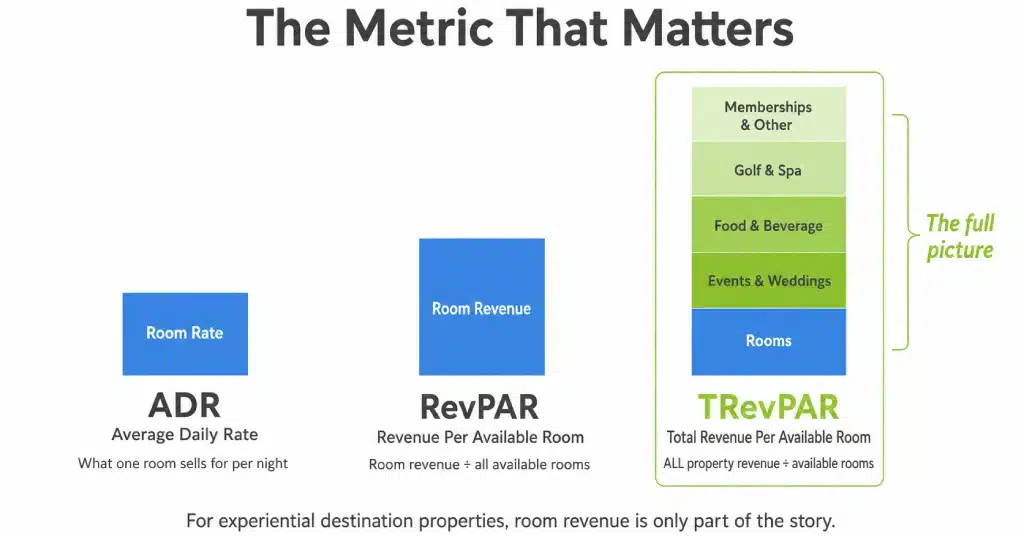
TRevPAR (total revenue per available room) captures the full revenue picture of experiential destination hospitality, where room revenue is only one of many income streams.
Contracted Event Revenue: The Downside Protection Layer
The most powerful structural advantage of experiential hospitality is contracted event revenue. Weddings, corporate retreats, and private events are booked and contracted well in advance. A bride rarely cancels her wedding because the stock market dropped or consumer confidence weakened. When leisure travel contracts in a downturn, contracted event revenue holds.
This creates a form of downside protection that most real estate asset classes can’t replicate. Multifamily has lease duration (typically 12 months) as its stabilizer. Industrial has long-term tenant leases. Experiential hospitality has forward-contracted event revenue, often with 12 to 18 months of visibility.
Properties that operate as major event venues, hosting hundreds of weddings and corporate events annually, have a revenue base that is substantially pre-committed before each operating period begins. Forward commitment doesn’t eliminate risk. Execution quality, weather events, and operator performance still matter. But it creates a structural floor that nightly-booking-dependent hotels simply don’t have.
Investors evaluating the downside resilience of a hospitality investment should ask what percentage of projected revenue is contractually committed versus dependent on transient bookings. The answer reveals how much of the revenue model is speculative versus locked in.
What Separates Qualified Hospitality Operators
The same complexity that makes experiential hospitality attractive to investors also makes it inaccessible to most operators. Managing a destination resort with multiple revenue streams, hundreds of employees, seasonal demand patterns, and contracted events across dozens of venues simultaneously requires operational depth that generalist real estate operators simply don’t possess.
Qualified hospitality operators share several characteristics. They have track records operating, not just acquiring, hospitality properties. They manage staffing at scale (hundreds of employees, not a handful of property managers). They have experience executing events at volume, managing multiple concurrent weddings, corporate retreats, and public programming. And they operate with a vertically integrated model where the same team that develops the investment thesis also manages the property day to day.
Fewer qualified operators means less competition for quality assets, better acquisition pricing, and returns that aren’t commoditized by market saturation. For investors, the complexity of the asset class is what protects the opportunity. But only when the operator can credibly execute.
To learn more about how experiential hospitality real estate is structured for accredited investors, visit accountableequity.com.
Frequently Asked Questions
What is TRevPAR and why does it matter for hospitality investors?
TRevPAR stands for total revenue per available room. It captures all revenue generated by the property, including rooms, dining, events, golf, memberships, and other streams, divided by available rooms. For experiential properties with multiple revenue streams, TRevPAR provides a far more accurate picture of investment performance than ADR or RevPAR alone.
Is experiential hospitality real estate more volatile than other asset classes?
Experiential hospitality has unique risk factors including operational complexity, staffing demands, and weather sensitivity. However, the contracted event revenue model provides forward booking visibility and downside protection that many other asset classes lack. As with all real estate investments, performance depends on the quality of the operator and the specific property’s market position. All investments involve risk, including the potential loss of principal.
How do investors evaluate a hospitality property if traditional hotel metrics don’t apply?
Request TRevPAR data instead of, or in addition to, ADR and RevPAR. Ask about the percentage of revenue from contracted events versus transient bookings. Evaluate the diversity of revenue streams. Assess the operator’s track record with this specific type of property, not just with real estate in general.
Can individual accredited investors access hospitality real estate investments?
Yes. Private real estate funds structured under Regulation D make hospitality investments accessible to accredited investors who meet applicable qualifications. These funds pool capital from accredited investors to acquire and operate properties alongside experienced sponsors. Each investor should review the PPM carefully and consult qualified professionals before investing.
Conclusion
Experiential destination hospitality outperforms traditional hotels for investors because it generates revenue from multiple simultaneous streams, not just room nights. The right metric is TRevPAR, not ADR. The downside protection comes from contracted event revenue. And the barrier to entry is what makes the returns available to investors who identify qualified operators.
For accredited investors evaluating private real estate allocations, experiential hospitality represents a differentiated asset class with structural advantages that conventional hotel, multifamily, and industrial investments don’t offer. But only when operated by sponsors with the depth and track record to execute. To learn more about how experiential hospitality real estate is structured for accredited investors, visit accountableequity.com.