

Learning how to read a Schedule K-1 from a real estate fund comes down to three areas: the income and deduction boxes in Part III, the capital account analysis in Item L, and the footnote statements attached behind the form. Depreciation is already inside the Part III numbers and has no line of its own.
Key Takeaways
- A Schedule K-1 (Form 1065) reports one partner’s share of a partnership’s income, deductions, credits and distributions for the tax year.
- Depreciation has no line of its own on the K-1. It is already subtracted inside the Box 1 or Box 2 figure.
- Item L shows a tax-basis capital account, which the IRS states cannot be used as the partner’s adjusted basis in the interest.
- Losses clear four limitations in order: basis, at-risk, passive activity under Form 8582, and excess business loss.
- Calendar-year partnerships file Form 1065 by March 15, with an extension available on Form 7004.
- A fund taxed as a partnership issues a Schedule K-1. A vehicle taxed as a corporation or a REIT reports on Form 1099-DIV instead.
In This Article
- What is a Schedule K-1, and why do real estate fund investors receive one?
- When does your K-1 arrive, and what should you do while you wait?
- Which boxes on a Schedule K-1 matter most to a limited partner?
- Where does depreciation show up on your K-1?
- What does the capital account analysis in Item L actually show?
- Why does my capital account show zero?
- Does a negative number on your K-1 mean you lost money?
- Does every private real estate investment produce a K-1?
- What should you hand your CPA?
- Frequently Asked Questions

Most investors meet their first Schedule K-1 the same way: a short form arrives, most of its boxes empty, a thick stack of statements behind it, and the one number they wanted nowhere in sight. The form is not difficult. It was built for a tax preparer, and it shows.
Investment in Accountable Equity funds is available only to independently verified accredited investors through an offering made in accordance with Rule 506(c) under Regulation D of the Securities Act of 1933.
This article is educational. Accountable Equity does not provide financial, legal, tax, or accounting advice, and nothing here is a substitute for reviewing your own Schedule K-1 with a qualified CPA who can see your full tax picture.
What is a Schedule K-1, and why do real estate fund investors receive one?
A Schedule K-1 (Form 1065) is the statement a partnership issues to each partner reporting that partner’s share of the partnership’s income, deductions, credits and distributions for the year. The partnership itself pays no federal income tax; the results flow through to the partners, who report them on their own returns.
Most private real estate funds are limited liability companies or limited partnerships taxed as partnerships. If you invest as a limited partner or non-managing member, the fund files Form 1065 and sends you a K-1.
Pass-through taxation is the treatment under which a partnership reports its results but pays no entity-level federal income tax, leaving each partner to report their share.
Everything else about the form follows from that. A K-1 is a tax allocation, not a performance report. Its income figures answer what the IRS treats as your share of the taxable result, which is a different question from how much cash you received.
When does your K-1 arrive, and what should you do while you wait?
Later than most first-time investors expect. Calendar-year partnerships must file Form 1065 by March 15 under the IRS Instructions for Form 1065, but a partnership that needs more time may extend on Form 7004, and real estate funds commonly do. Treat March 15 as the earliest plausible date.
The hold-up is usually the books themselves. A fund that owns operating property cannot close them until property-level accounting, depreciation schedules and any cost segregation work are finalized, and a fund holding interests in other entities must wait on those entities’ own K-1s before it can issue yours. In this asset class an extension is the normal case.
If a K-1 is going to be late, tell your CPA early so they can extend your personal return. Amending after a late K-1 arrives is slower and more expensive.
- Watch for a Schedule K-3 or a notice about one if the fund has any foreign-source items. It is separate from the K-1 and sometimes arrives later.
- You may also receive a state K-1 or a composite filing notice for each state where the fund operates. A fund with properties in more than one state can create a filing obligation in each.
Which boxes on a Schedule K-1 matter most to a limited partner?
A small number of lines carry nearly all of the meaning, and much of the rest of the form is blank. The table below covers the lines that most often hold a number.
| Line on the K-1 | What the line reports | What it means to a limited partner |
|---|---|---|
| Part II, Item J | Your profit, loss and capital percentages at the start and end of the year | Shows whether your ownership share changed during the year, usually because the fund admitted new capital |
| Part II, Item K | Your share of the partnership’s liabilities, split by type | Feeds your outside basis calculation, which is one reason the capital account in Item L is not your basis |
| Part II, Item L | Capital account analysis on the tax basis method | Beginning balance, contributions, current-year income or loss, withdrawals and distributions, ending balance |
| Box 1 | Ordinary business income or loss | Where an operating business reports its result. A hotel or resort that sells rooms, food and events is an operating business |
| Box 2 | Net rental real estate income or loss | Generally a passive activity amount for all partners, per the IRS Partner’s Instructions, with a narrow exception for qualifying real estate professionals |
| Box 5 | Interest income | Usually small. Reserve account and operating account interest |
| Box 9c | Unrecaptured section 1250 gain | Appears when depreciated real property is sold. Taxed at its own rate |
| Box 13 | Other deductions, by code | Where items such as investment interest expense and certain fees are reported |
| Box 19, code A | Cash and marketable securities distributed | The cash you actually received. This figure stands apart from the income figure in Box 1 or Box 2 |
| Box 20, code Z | Section 199A information | The data your CPA needs to test the qualified business income deduction. Often carried on an attached statement |
| Boxes 22 and 23 | At-risk and passive activity checkboxes | When checked, a required statement is attached behind the form. Do not discard it |
Source: IRS, Partner’s Instructions for Schedule K-1 (Form 1065).
The income line and the distribution line are easy to confuse, and in a real estate fund they can differ substantially in either direction. A year with meaningful depreciation can show a loss in Box 2 and a positive cash distribution in Box 19.
Where does depreciation show up on your K-1?
Depreciation does not get its own box on the Schedule K-1. It is already subtracted inside the net figure reported in Box 1 or Box 2, which is why investors expecting a visible depreciation line never find one.
The detail lives behind the form. Partnerships commonly attach a supplemental statement showing the depreciation taken, and a fund that has run a cost segregation study usually explains the effect there. That attachment is where to find the number itself.
A cost segregation study reclassifies portions of a property into shorter recovery periods, and assets with recovery periods of twenty years or less can be eligible for bonus depreciation. That rate is currently 100 percent for qualifying property both acquired and placed in service after January 19, 2025 under the One Big Beautiful Bill Act. Property acquired on or before that date stays under the earlier phase-down schedule.
A large deduction in an early year can turn a cash-positive property into a taxable loss on paper.
That is how the arrangement is meant to work, and it is also where the limits arrive. A paper loss is only useful to the extent the rules let you use it, and for most limited partners those rules are restrictive.
How the loss limitations stack
The IRS Partner’s Instructions state that the amounts in Boxes 1 through 21 are shown before limitations, and that limitations apply in a set order: adjusted basis in the partnership interest first, then the at-risk amount, then the passive activity rules, then excess business loss.
For a limited partner, the passive activity step is usually the binding one. Box 2 rental real estate amounts are generally passive, disallowed passive losses are figured on Form 8582, and the special allowance that lets some taxpayers deduct rental losses against other income is not available on an interest held as a limited partner.
Disallowed losses are not lost. Under the passive activity rules described in IRS Publication 925, they are suspended and carried forward, available against future passive income from the activity or generally released when the interest is disposed of in a fully taxable transaction. Your CPA tracks that carryforward year over year.
What does the capital account analysis in Item L actually show?
Item L shows your capital account on a tax basis method: a beginning balance, capital contributed during the year, your share of current-year net income or loss, withdrawals and distributions, and an ending balance. It is the one place on the form where the year reconciles.
It is also widely misread, because it is not your basis. The IRS Partner’s Instructions say plainly that the tax-basis capital account cannot be used to figure the partner’s adjusted basis in the partnership interest, chiefly because adjusted basis includes your share of partnership liabilities and the capital account does not.
Tracking your outside basis is your job. The partnership does not have visibility into partner-level adjustments, so the instructions direct each partner to maintain their own basis calculation annually. Ask your preparer whether they maintain that worksheet for you.
The practical rule: read Item L to understand what happened inside the fund this year. Read your own basis worksheet to understand what you are allowed to deduct.
Why does my capital account show zero?
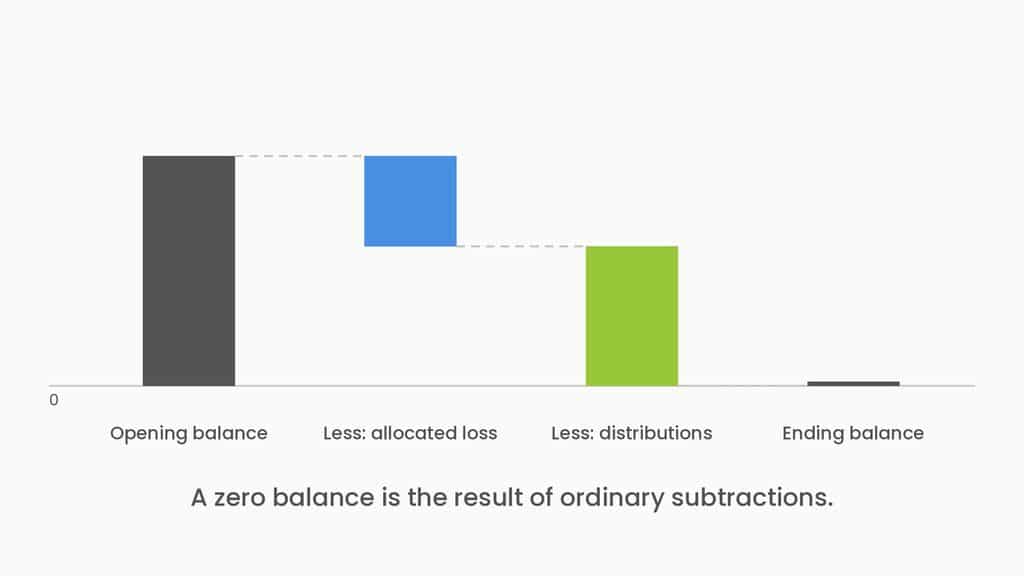
Because the running total has been drawn down to the bottom. A zero balance in Item L does not mean your interest has no value, that the investment has ended, or that you stopped owning anything.
The account starts with what you contributed. Allocated income adds to it. Allocated losses and distributions subtract from it. In real estate both subtractions tend to be large, because depreciation produces allocated losses in the same years the property is distributing cash.
Three paths lead there, all of them ordinary.
- Cumulative depreciation losses have reduced the balance year after year.
- Distributions have exceeded the income allocated to you, the usual pattern when depreciation shelters the cash paid out.
- A refinancing or sale returned your original capital, and the account was reduced accordingly.
What matters after that is your basis. IRS Publication 541 states that adjusted basis is reduced by distributions but not below zero, and that a cash distribution is taxable only to the extent it exceeds that basis. A capital account at zero creates no tax bill. A distribution larger than your basis does, generally as capital gain.
Basis usually outlasts the capital account, which is why distributions often keep coming untaxed after Item L reaches zero. Adjusted basis includes your share of the partnership’s liabilities and the capital account does not, so in a fund carrying a mortgage your basis can sit well above zero long after Item L is drawn down. Each distribution reduces that basis, and stays a return of capital until it runs out.
The two figures also behave differently at the bottom. A tax-basis capital account can show a negative ending balance. Basis stops at zero. If your Item L balance is at or near zero, the number to ask your CPA for is your basis.
Does a negative number on your K-1 mean you lost money?
No. A negative number on a K-1 is a tax result, not a statement about the value of your investment or the performance of the property. In real estate funds, negative figures are common in years when the asset is performing exactly as planned.
Two negative numbers get mistaken for bad news.
- A loss in Box 1 or Box 2 usually reflects depreciation. The property can be generating cash and still report a taxable loss, which is the ordinary arithmetic of a depreciating hard asset.
- A falling or negative balance in Item L reflects distributions and allocated losses drawing the account down, which is the expected pattern in a fund that carries debt.
What a K-1 cannot tell you is how the investment is doing. Valuation, occupancy, debt service coverage and distribution history live in the fund’s investor reporting. Reading performance out of a K-1 is the most common error investors make with it, and the most avoidable.
Does every private real estate investment produce a K-1?
No. The tax document follows the structure of the investment, and two investors in the same portfolio of properties can receive entirely different forms.
The examples below describe structures that are common in private real estate. They are illustrative. Your own fund’s operating agreement and offering documents govern how that entity is taxed and what it will send you.
| What you hold | How the entity is usually taxed | Typical tax document |
|---|---|---|
| An equity interest in a fund organized as a partnership, or as an LLC treated as one | Passed through to the partners or members | Schedule K-1 (Form 1065) |
| An equity interest in a fund organized as an S corporation | Passed through to the shareholders | Schedule K-1 (Form 1120-S) |
| Shares in a vehicle taxed as a corporation or a REIT | Taxed at the entity level, then paid out as dividends | Form 1099-DIV |
| A note or other debt position in a lending vehicle | Interest income to the holder | Form 1099-INT, or Form 1099-DIV where the vehicle itself is taxed as a corporation or a REIT |
Source: IRS instructions for Forms 1065, 1120-S and 1099.
Sponsors often run more than one of these side by side: equity funds that own property, leasing funds that finance equipment, and debt funds that lend against it. An investor holding positions across a sponsor’s offerings can receive several K-1s plus one or more 1099s in a season.
The K-1s will not look alike either. A fund that operates a hotel reports in different boxes from a fund whose only activity is leasing equipment, and the two create different state filing footprints. That is why the folder you hand your CPA should be organized by fund.
What should you hand your CPA?
Hand over the complete package for each fund, every page of it. The attachments behind a K-1 frequently carry the information that determines how the form is actually reported.
- Confirm the basics first: your name, your taxpayer identification number, the partnership’s EIN, the tax year, and whether the form is marked limited partner or other LLC member. An error there is far easier to fix before a return is filed.
- Collect every page the fund sent, including the supplemental statements, the depreciation detail, the section 199A statement and anything referenced by the Box 22 or Box 23 checkboxes.
- Add the state K-1s and any composite filing notices, keeping them grouped with the federal K-1 from the same fund.
- Include last year’s K-1 for the same fund, so your preparer can tie the Item L beginning balance to the prior ending balance and carry forward any suspended passive losses.
- Ask two specific questions: what is my current outside basis in this fund, and what passive loss carryforward am I holding. Keep both answers in a worksheet of your own.
If a figure looks wrong, raise it with the fund’s investor relations team before the return is filed. A corrected K-1 that arrives before filing costs you a phone call. One that arrives afterward means an amended return.
Frequently Asked Questions
What is a Schedule K-1 in real estate investing?
A Schedule K-1 (Form 1065) is the annual statement a real estate partnership sends each investor reporting that investor’s share of the entity’s income, deductions, credits and distributions. The partnership files Form 1065 and pays no federal income tax itself. Each partner reports their allocated share on their own return. Investors in funds structured as partnerships or as LLCs taxed as partnerships receive one for each fund they hold.
Why is my K-1 showing a loss when I received distributions?
Because the two numbers measure different things. The income or loss in Box 1 or Box 2 is a tax allocation calculated after depreciation, while the distribution in Box 19 is the cash the fund actually paid you. Depreciation on a real property asset can produce a taxable loss in a year when the property generated and distributed cash. A loss on the form is not a statement that the investment lost value.
Where is depreciation reported on a Schedule K-1?
Depreciation does not appear on its own line. It is already deducted inside the net figure in Box 1 or Box 2, which is why no separate depreciation box exists on the form. Funds commonly attach a supplemental statement showing the depreciation taken, and a fund that completed a cost segregation study will usually describe the effect there. Ask the fund for that attachment if it is missing.
Can I use a K-1 loss against my salary or other income?
Usually not. Rental real estate losses reported in Box 2 are generally passive activity amounts, and the IRS Partner’s Instructions state that the special allowance permitting some taxpayers to offset rental losses against other income is not available on an interest held as a limited partner. Disallowed passive losses are figured on Form 8582, suspended, and carried forward against future passive income or released on a fully taxable disposition.
When should I expect my K-1 to arrive?
Plan for later than March 15. Calendar-year partnerships must file Form 1065 by that date under the IRS Instructions for Form 1065, but a partnership may extend on Form 7004 and real estate funds commonly do. A fund that owns operating property cannot close its books until depreciation schedules and any cost segregation work are final. Tell your CPA early; extending your personal return is cheaper than amending it later.
Why does my K-1 show a capital account of zero?
A zero balance in Item L means allocated losses and distributions have reduced the account to zero, which is common in real estate funds that carry debt. It does not mean your interest has no value or that the investment has ended. Item L is a tax-basis capital account, and the IRS Partner’s Instructions state it cannot be used as your adjusted basis. Basis is what matters next, because a distribution is taxable only to the extent it exceeds basis.
Do all private real estate funds issue a K-1?
No. The document follows how the entity is taxed and what interest you hold. A fund organized as a partnership, or as an LLC treated as one, issues a Schedule K-1 on Form 1065. A vehicle taxed as a corporation or a REIT reports dividends on Form 1099-DIV, and a note generally produces interest income on Form 1099-INT. One sponsor’s offerings can produce a mix in the same season.
The Form Is Readable Once You Know What It Is Measuring
A Schedule K-1 is a tax allocation, not a performance report, and nearly every confusion it causes traces back to that distinction. Read the income boxes for your taxable result, Item L for how the fund’s books moved, and Box 19 for the cash you were paid. Expect the three to disagree, because depreciation sits inside the numbers. The next question worth understanding is how a fund decides what cash reaches investors at all.