
A zero capital account on your K-1 does not mean your investment lost money. The capital account is a running tax tally, not a statement of value. Depreciation deductions drive it toward zero while the property itself stays intact, but reaching zero does change how you are taxed going forward.
Key Takeaways
- A capital account tracks contributions, allocated income, allocated losses and distributions. It is not a measure of what an investment is worth.
- Accelerated depreciation creates non-cash losses that can drive a capital account to zero within a few years of a closing.
- The IRS states that the capital account shown on a K-1 cannot be used to figure a partner’s adjusted tax basis.
- Once a capital account reaches zero, distributions are more likely to be taxable and further allocated losses may be suspended.
- Many passive investors never deducted the full loss their K-1 reported, because passive losses generally offset only passive income.
- Depreciation claimed early is generally recaptured at sale, at a maximum federal rate of 25 percent on unrecaptured Section 1250 gain.
EDUCATION, NOT TAX ADVICE
Accountable Equity does not provide tax, legal or accounting advice. This article explains how these mechanics generally work across real estate partnerships, not how they apply to you. Your own position depends on facts this article cannot see, so speak with your own CPA or tax advisor before acting on anything here.
In This Article
- What does a zero capital account on a K-1 actually mean?
- What does a capital account measure?
- Why does depreciation drain a capital account so quickly?
- Is the loss on your K-1 a paper loss or a real loss?
- Why does allocated income sometimes match distributions exactly?
- What changes once your capital account reaches zero?
- Did you actually deduct the loss your K-1 reported?
- What happens to depreciation when the property is sold?
- Four questions to bring to your tax advisor
- Where these rules are actually written down
- Frequently Asked Questions
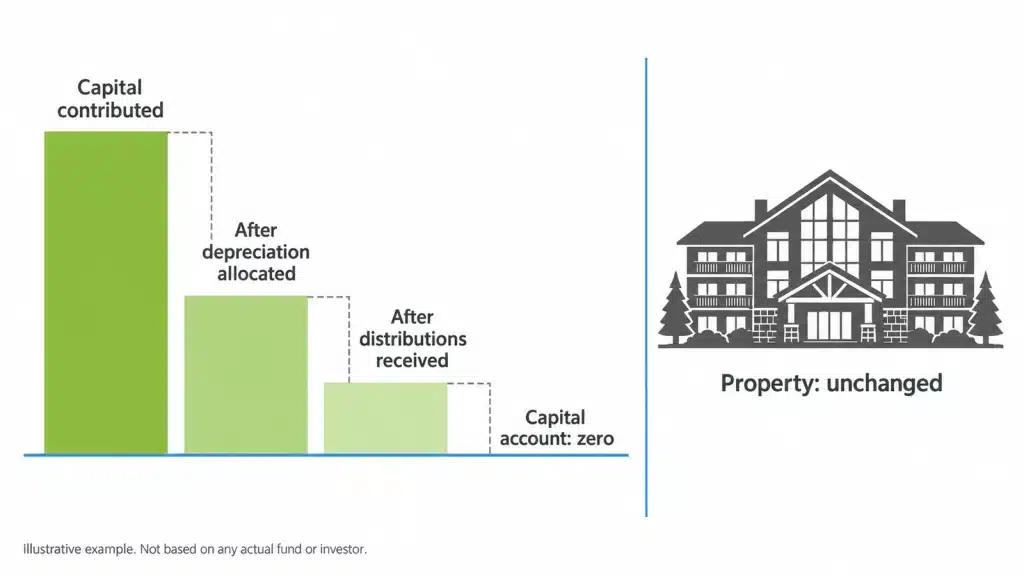
Item L of a Schedule K-1 reports the partnership’s record of a partner’s capital account. It is not a statement of investment value. Illustrative example.
What does a zero capital account on a K-1 actually mean?
It means the tax accounting for your position has been reduced to zero. It does not mean the investment is worth nothing, and it does not mean the investment is doing well either. The number answers a different question than the one most investors think they are asking when they look at it.
Investors who open a K-1 for the first time often read the capital account line the way they would read a brokerage statement. That instinct is reasonable and it is wrong. A brokerage statement reports value. A capital account reports tax history.
Whether the investment has gained or lost value is a separate question, and the answer comes from the fund’s performance reporting rather than from this line on a tax form.
What does a capital account measure?
A capital account is a running tally of what you put in, what was allocated to you, and what you took out. It starts at the amount you contributed and moves every year based on four inputs.
Capital account. The partnership’s record of your economic position, reported in Item L of your Schedule K-1.
The account decreases by:
- Losses allocated to you, including non-cash losses such as depreciation
- Cash distributions paid to you
The account increases by:
- Income allocated to you
- Any additional capital you contribute
None of those four inputs is a valuation. A property can appreciate substantially while the capital account attached to it falls to zero, because appreciation does not appear anywhere in that calculation until the property is sold.
There is a second number that matters more than this one, and most investors have never heard of it.
Outside basis. Your own tax investment in the partnership interest, which governs what is taxable to you and which you are responsible for tracking yourself.
The IRS is direct about the difference. The Partner’s Instructions for Schedule K-1 state that the capital account information “is based on the partnership’s books and records and can’t be used to figure the partner’s adjusted basis.” The same instructions state that it is the partner’s responsibility to track the information needed to figure that basis.
| Comparison point | Capital account | Outside basis |
|---|---|---|
| What it reports | The partnership’s record of your economic position | Your tax investment in the partnership interest |
| Who maintains it | The partnership | You |
| Shown on your K-1 | Yes, in Item L | No |
| Used to figure your taxable gain | No | Yes |
| Can differ between two partners who invested the same amount | Rarely | Yes, depending on individual tax history |
Two investors can show identical capital accounts and hold different outside bases, because basis follows each person’s own tax history with the partnership.
Why does depreciation drain a capital account so quickly?
Depreciation is a deduction you receive without spending any cash, and in the early years of a real estate partnership it is usually the largest single item allocated to you. That deduction reduces your capital account even though nothing left your pocket.
The mechanism that accelerates it is cost segregation. A cost segregation study separates a building into components with different depreciable lives, so that qualifying items such as carpeting, decorative lighting, cabinetry, appliances and site improvements can be written off over five, seven or fifteen years rather than over the decades that apply to the structure itself. Not everything in those categories reclassifies, and the split depends on the property and on the engineer’s analysis.
Under current law, bonus depreciation then allows much of the qualifying shorter-life property to be claimed in the year it is placed in service.
The result is a large loss allocation in years one and two, followed by smaller ones. A capital account can reach zero well before the partnership has done anything other than operate the property normally.
There is an asset-class dimension to this that generic tax content tends to miss. In our experience operating resort and hospitality properties, these assets carry a high proportion of personal property relative to the structure, since guest rooms, kitchens, event spaces and amenity areas are full of furniture, fixtures and equipment. That mix tends to produce a larger short-life component in a cost segregation study.
How much of this applies to any particular partnership depends on the property and the study, and your CPA is the person to confirm it.
If you want the mechanics of the deduction itself rather than its effect on your capital account, our explanation of how bonus depreciation works in real estate covers that ground.

Hospitality assets carry a high proportion of personal property, which a cost segregation study assigns to shorter depreciable lives.
Is the loss on your K-1 a paper loss or a real loss?
The K-1 does not tell you directly, which is why this causes so much confusion. Your share of the year’s result arrives as a single figure that blends operating results with depreciation, without separating them.
Which line that figure lands on depends on how the partnership’s activity is classified. Long-term rental real estate is usually reported in Box 2 as net rental real estate income or loss. An operating business is reported in Box 1 as ordinary business income or loss.
Hotels and resorts generally fall in Box 1. Under the passive activity regulations, an activity is not a rental activity when the average period of customer use is seven days or less, or thirty days or less where significant personal services are provided. A few nights with housekeeping and a front desk is a business, not a rental.
So look at whichever of the two boxes carries a figure on your K-1. Many partnerships populate one and leave the other blank, and a blank box tells you nothing about how the property performed.
A partnership can collect more cash than it spends and still report a loss on the K-1, because depreciation is subtracted after the cash math is done. This is the normal condition for a real estate partnership in its early years, not a warning sign.
To see the composition, look at the supplemental statements attached to the K-1 rather than at the form itself. Partnerships commonly attach a statement itemising the components behind that figure, including depreciation. What those attachments contain varies by partnership, so if you are trying to work out whether a property underperformed or simply depreciated, that is a question for your CPA with the full K-1 package in front of them.
The distribution line is the other useful signal. A partnership that distributed cash to you during a year in which it reported a loss was generating cash to distribute.
Why does allocated income sometimes match distributions exactly?
Because the partnership agreement governs how income and loss are allocated, and those provisions can produce an income allocation that mirrors the distribution. What you are seeing is the allocation mechanism at work, not a business result.
Investors sometimes notice that a K-1 reports allocated income identical to the distributions they received, down to the dollar, and reasonably assume the fund earned exactly what it paid out. That is not what happened. The partnership agreement governs how income and loss are allocated once an account is exhausted, and the arithmetic that produces the match is a consequence of those provisions rather than a coincidence.
The figures are accurate. They are just answering a question about allocation rather than a question about operations.
What changes once your capital account reaches zero?
Three things change, and they deserve as much attention as the reassurance does. Reaching zero is not a problem, but it is a turning point, and the tax treatment on the other side of it differs from what you experienced in the first few years.
- Distributions become more likely to be taxable. In the early years, distributions are frequently treated as a return of capital rather than income. Once basis is exhausted, that treatment generally stops and distributions are more likely to produce taxable gain.
- Further allocated losses may be suspended rather than deducted. A loss you cannot currently use does not disappear. It is carried forward and waits until there is basis or passive income to absorb it.
- Gain at exit is measured against a reduced basis. Every deduction you took reduced your basis. When the property sells, taxable gain is calculated from that lower number, which makes the gain larger than the difference between purchase price and sale price alone would suggest.
None of these is a penalty. They are the back half of a bargain whose front half was several years of sheltered income.
Did you actually deduct the loss your K-1 reported?
Possibly not, and this is the single most common misunderstanding in this entire subject. A loss reported on your K-1 is a loss allocated to you. Whether you were permitted to deduct it in that year is a separate question with its own set of rules.
Most investors in a syndication are passive under the material participation rules, because they have no operational role in the property. IRS Publication 925, Passive Activity and At-Risk Rules, sets out the tests for material participation, and an investor who contributes capital and receives periodic reports will not normally meet any of them. How the rules apply to your particular interest depends on the entity and on your own facts, which is a question for your CPA.
Suspended loss. A passive loss you were not allowed to deduct in the year it was allocated, carried forward until you have passive income to absorb it or you dispose of the activity.
The consequence is that a passive loss can generally offset only passive income. If you had no other passive income that year, the deduction was limited, and the unused portion was reported on Form 8582 and carried forward rather than applied against your salary or your portfolio income.
So an investor can hold a K-1 showing a substantial loss, believe they received a substantial tax benefit, and find on inspection that most of it is sitting in a carryforward. The benefit is real. The timing is often different from what was assumed.
Publication 925 also explains what happens to those suspended amounts eventually, which matters more than it sounds.
What happens to depreciation when the property is sold?
The deductions taken early are generally recaptured, which means a portion of the gain at sale is taxed to reflect the depreciation you previously claimed. This is the part of the arc that most sponsor content leaves out.
Depreciation recapture. The portion of gain at disposition attributable to depreciation deductions claimed in prior years.
For real property, the relevant category is unrecaptured Section 1250 gain. IRS Topic No. 409 states that unrecaptured Section 1250 gain from selling Section 1250 real property “is taxed at a maximum 25% rate,” which sits above the long-term capital gains rates that apply to the remainder of the gain.
There is a meaningful offset on the other side. When an investor disposes of an entire interest in a passive activity in a fully taxable transaction, previously suspended passive losses generally become deductible. The carryforward that had been sitting unused frequently comes into play in the same year the recapture does.
Whether those two forces roughly cancel, or one dominates, depends on your basis, the size of the gain, your other income that year, your state, and the rules in effect at the time. Nobody can tell you the answer from the outside. That is a conversation with your own tax advisor, and it is worth having before the sale rather than after it.
Accelerated depreciation is a timing shift. It defers tax rather than eliminating it. That is still valuable, because deferral has real economic worth, but it is not the same thing as permanent savings and it should not be described that way.
Four questions to bring to your tax advisor
Bring specifics rather than the form. A general instruction to consult a professional is not useful, so here are the four questions that will get you an actual answer.
- How much of my allocated loss did I actually deduct, and how much was suspended?
- What is my current outside basis in this investment?
- How will future distributions from this partnership be taxed to me?
- Given my basis, what should I expect at disposition?
Bring the K-1 and every statement attached to it, plus your Form 8582 if one was filed. An advisor who can see the carryforward can answer the first two questions in a few minutes.
Where these rules are actually written down
The allocation rules that govern your capital account are in the partnership’s offering documents, specifically the Private Placement Memorandum and the Operating Agreement or Limited Partnership Agreement. Those documents are the authority for how income, loss, distributions and exit proceeds are handled in your particular investment.
This article explains how the mechanics generally work across real estate partnerships. It cannot tell you how your partnership allocates, because that is a document-specific question and the terms vary between sponsors.
If you have not read those sections closely, they are worth the hour. Our guide to how to read a private placement memorandum covers what to look for, and the tax benefits of real estate syndication explains the deductions themselves in more depth.
Frequently Asked Questions
Does a zero capital account mean I lost my investment?
No. A zero capital account means the tax accounting for your position has been reduced to zero, usually by depreciation deductions allocated to you. It carries no information about whether the underlying property gained or lost value. Fund performance reporting answers that question, and the capital account answers a different one.
Can a capital account go negative?
Yes. Since 2020 the IRS has required partnerships to report Item L on the tax basis method, and a tax basis capital account can go negative. It often reflects distributions and allocated losses exceeding contributions, which is common in leveraged real estate partnerships. Your outside basis is a separate figure and, unlike the capital account, cannot be reduced below zero.
Is the capital account the same as my tax basis?
No, and the IRS is explicit on this point. The Partner’s Instructions for Schedule K-1 state that the capital account information cannot be used to figure the partner’s adjusted basis. Basis follows your own tax history with the partnership under separate rules, and it is the partner’s responsibility to track it rather than the partnership’s.
Why did my K-1 show a loss when the property is doing fine?
Because depreciation is subtracted after the operating math is done. A partnership can collect more cash than it spends, distribute some of it to you, and still report a net loss on the K-1 once depreciation is applied. In the early years of a real estate partnership this is the normal pattern rather than a warning sign.
Did I actually get the tax benefit my K-1 loss suggests?
Not necessarily in that year. Most syndication investors are passive under the material participation rules, and a passive loss generally offsets only passive income. Without sufficient passive income, the unused portion was suspended on Form 8582 and carried forward. The benefit is not lost, but the timing is often later than investors assume.
What happens to my suspended losses if I never have passive income?
They continue to carry forward. When you dispose of your entire interest in the passive activity in a fully taxable transaction, previously suspended losses generally become deductible, which often coincides with the year the sale produces gain and recapture. IRS Publication 925 sets out how the disposition rules work.
Should I be worried if my capital account hits zero in year two?
Not on that basis alone. Reaching zero quickly usually reflects accelerated depreciation working as intended, particularly in asset classes with a high proportion of shorter-life property. What it should prompt is a conversation with your tax advisor about how the next few years will be treated differently, because distributions and further losses are handled differently once the account is exhausted.
The Bottom Line
The capital account on your K-1 is a tax record, not a scorecard for your investment. Reaching zero is a normal outcome of accelerated depreciation and tells you nothing about how the property is performing. What it does tell you is that the tax treatment of your position is entering a different phase, one where distributions are more likely to be taxable and where the eventual sale will be measured against a reduced basis.
That is worth understanding before it happens rather than after. If you would like the educational materials we produce for investors working through these mechanics, or you would prefer to talk it through, our team is available for that conversation.
Accountable Equity does not provide tax, legal or accounting advice, and nothing here is a substitute for guidance from your own advisor on your own situation.