
A real estate syndication is genuinely illiquid: your capital is typically committed for a defined hold period of roughly five to seven years, and there is no public market where you can sell your position on demand. But the more useful question about real estate syndication liquidity is not “can I get my money out?” It is “what am I being compensated for in exchange for that commitment, and does the return premium justify the lockup?” In private markets, illiquidity is not a flaw bolted onto the structure. It is the mechanism that makes a value-add strategy possible, and it is the reason a return premium can exist at all. This article explains how illiquid a syndication actually is, what the typical hold periods look like, the limited secondary-market options that do exist, and why the commitment period is better understood as a feature with a premium than as a penalty to be endured.
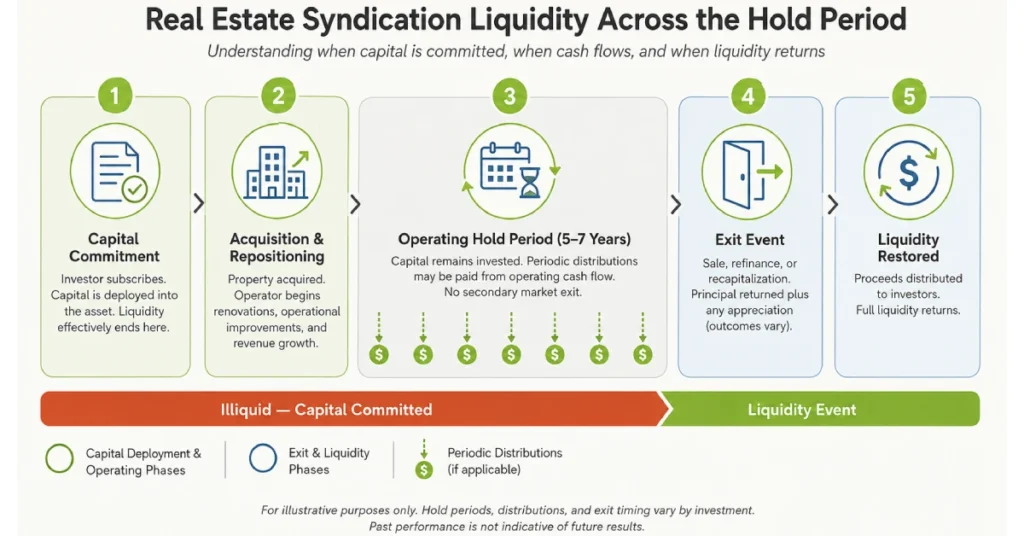
The real question about real estate syndication liquidity isn’t whether you can exit early — it’s what the commitment period is designed to earn.
Accountable Equity offers investment opportunities exclusively to verified accredited investors under Rule 506(c) of Regulation D. All investors must meet applicable qualification requirements as defined by the SEC. For a detailed overview of who qualifies as an accredited investor, visit our accredited investor resource page.
In This Article
- What Real Estate Syndication Liquidity Actually Means
- How Long Is the Typical Hold Period?
- What Limits Real Estate Syndication Liquidity in the Secondary Market
- Why Illiquidity Enables the Value-Add Strategy
- The Illiquidity Premium: What You Are Compensated For
- Frequently Asked Questions
What Real Estate Syndication Liquidity Actually Means
Real estate syndication liquidity refers to how quickly, and at what cost, you can convert your investment back into cash. In a syndication, the honest answer is that liquidity is low by design. Your money is pooled with other accredited investors to acquire and improve a specific property, and it stays invested until the asset is sold or refinanced.
This is fundamentally different from owning a publicly traded stock or a REIT share, which you can sell in seconds during market hours. That instant access is convenient, but it comes at a cost most investors never see: the price of a public security moves every second on sentiment, headlines, and crowd behavior, not just on the underlying fundamentals. You trade certainty of value for certainty of access.
A syndication makes the opposite trade. You give up the ability to exit on a whim, and in return your capital is insulated from the daily mood of the market. The investment is valued on the performance of a real, operating asset over a multi-year period. Understanding real estate syndication liquidity this way reframes the entire question: the lockup is not hiding a weakness in the structure, it is defining what kind of return the structure is built to produce.
How Long Is the Typical Hold Period?
Most real estate syndications have a target hold period of roughly five to seven years, though the exact timeline varies by strategy, asset type, and market conditions. The hold period is the stretch of time between when you commit capital and when the asset is expected to be sold or refinanced, returning capital to investors.
That timeline is not arbitrary. It reflects how long it actually takes to execute a business plan on a physical property. A value-add strategy — acquiring an underperforming or distressed asset and improving it — needs time to complete renovations, build occupancy or membership, grow revenue, stabilize operations, and then sell or refinance into a stronger position. Compressing that work into a shorter window would mean exiting before the value has been created.
It is also worth being clear that the hold period is a target, not a promise. Sponsors aim to exit within the projected window, but real estate is cyclical, and a disciplined operator will sometimes hold longer to avoid selling into a weak market. A responsible sponsor sets expectations honestly: a syndication asks for patient capital, and investors should commit only money they will not need during the hold period.
How Investors Receive Cash Before the Exit
Although your principal is committed for the full term, that does not always mean no cash flows back to you in the interim. Many syndications make periodic distributions from the property’s operating income during the hold. Accountable Equity’s distributions are primarily annual, reflecting the operating rhythm of destination hospitality assets where revenue builds across a full seasonal cycle.
These distributions are a return of operating cash flow during the commitment period, not a way to withdraw your principal early. The bulk of the invested capital remains at work in the asset until the sale or refinance event. This is an important distinction: receiving a distribution is not the same as having liquidity.
What Limits Real Estate Syndication Liquidity in the Secondary Market
There is no robust secondary market for private real estate syndication interests, and investors should not count on selling early. While a handful of private platforms have emerged that attempt to match buyers and sellers of LP interests, this market is thin, inconsistent, and far from dependable. Treating an early exit as a reliable backstop is a mistake.
Even where a sale is possible, several frictions apply. Most syndication operating agreements require sponsor approval to transfer an interest, and any new buyer must themselves be a verified accredited investor. Because there is no transparent pricing and few buyers, an interest that does sell often does so at a discount to its underlying value. In practice, the seller absorbs that discount as the cost of early access to cash.
Some sponsors also outline limited redemption or transfer provisions in their offering documents — for example, allowing transfers to family members or estate-planning vehicles. These vary entirely by deal and should never be assumed. The only dependable source of truth is the specific subscription and offering documents for a given investment, which is exactly why investors are advised to read them carefully and ask the sponsor directly how transfers and exits are handled.

Renault Winery Resort, Egg Harbor City, NJ — owned by the funds offered by Accountable Equity and operated by VIVÂMEE Hospitality.
Why Illiquidity Enables the Value-Add Strategy
Illiquidity is the precondition for the value-add strategy that drives private real estate returns. To transform an underperforming property into a more valuable one, an operator needs capital that stays in place long enough to do the work. Patient capital is what allows a sponsor to act on a multi-year plan rather than react to short-term market noise.
Consider how this plays out in destination hospitality. The funds offered by Accountable Equity own assets that VIVÂMEE Hospitality operates, such as Renault Winery Resort in Egg Harbor City, NJ — a property acquired out of bankruptcy and repositioned into a destination resort. That kind of transformation, where revenue is rebuilt across vineyard, winemaking, and wine experiences, hospitality, weddings, and events, cannot happen overnight. It requires renovation, rehiring and retraining, rebuilding a booking pipeline, and several full operating seasons to stabilize.
If investors could withdraw capital at any moment, none of this would be possible. A forced sale triggered by an investor needing liquidity in year two would crystallize a loss before the business plan had a chance to work. The lockup protects every investor in the deal from the impatience or changing circumstances of any single one. In other words, illiquidity is not the price of admission — it is the structural feature that lets the strategy create value in the first place.
This is also a high barrier to entry that works in investors’ favor. Because most capital cannot tolerate a multi-year commitment, fewer buyers compete for these assets, which can translate into better entry pricing for the patient capital that can.
The Illiquidity Premium: What You Are Compensated For
The illiquidity premium is the additional return investors can potentially earn as compensation for giving up access to their capital for a set period. It is the economic answer to the central question of this article: you are not simply locking up money, you are being paid for the constraint that illiquidity imposes.
The logic is straightforward. Capital that can leave at any time is cheap and abundant, so it earns less. Capital that commits for years is scarcer and more valuable to an operator executing a long-term plan, so it can command a premium. Private, illiquid investments have historically been associated with the potential for higher returns than comparable liquid public alternatives — in part as compensation for that very lack of liquidity. This is a structural feature of how markets price commitment, not a promise about any specific deal.
None of this means the premium is certain or that every illiquid investment outperforms. Returns are never assured, principal can be lost, and the premium is a potential reward for accepting real risk and a real loss of flexibility. The disciplined way to evaluate any syndication is to weigh the projected return against the length and certainty of the commitment, and to invest only capital you can leave untouched for the full hold period.
Evaluating that trade-off is part of standard due diligence. Understanding how a sponsor structures its hold periods, distributions, and exit strategy tells you a great deal about how they think about investor capital. You can learn more about how a vertically integrated operator approaches these structures through the Accountable Equity investor resources.
Frequently Asked Questions
How illiquid is a real estate syndication compared to a stock?
A real estate syndication is far more illiquid than a stock. A publicly traded stock can be sold in seconds during market hours, while a syndication interest is typically committed for a five-to-seven-year hold period with no public market to sell into. The trade-off is that syndication value is tied to a real operating asset rather than to the minute-by-minute sentiment that moves public share prices.
Can I sell my real estate syndication investment early?
Usually not easily. There is no robust secondary market for private syndication interests, and most operating agreements require sponsor approval to transfer a position to another verified accredited investor. Where an early sale is possible at all, it often happens at a discount, so investors should plan to hold for the full term and treat early liquidity as the exception, not the rule.
What is the illiquidity premium in real estate syndication?
The illiquidity premium is the additional return investors can potentially earn in exchange for committing capital for a fixed period without the ability to sell on demand. Because patient capital is scarce and valuable to operators executing multi-year business plans, private illiquid investments have historically been associated with the potential for higher returns than comparable liquid alternatives. It is a potential reward for accepting real risk, never a certain outcome.
Do I receive any money during the hold period?
Often, yes. Many syndications make periodic distributions from a property’s operating cash flow during the hold, and Accountable Equity’s distributions are primarily annual. These payments reflect operating income, however, and are not a way to withdraw your principal early — the bulk of your invested capital stays at work in the asset until it is sold or refinanced.
Reframing Illiquidity as a Feature, Not a Flaw
Real estate syndication liquidity is genuinely limited, and that is the point. The commitment period is what gives an operator the patient capital to execute a value-add strategy, and it is the source of the potential return premium that compensates investors for the lockup. Being honest about hold periods and the thin secondary market is not a weakness in the pitch — it is the foundation of a sound one.
The right question is not whether you can get your money out quickly, but whether the potential reward justifies the commitment for your situation. If you want to understand how a vertically integrated sponsor structures hold periods and distributions, explore the Accountable Equity investor resources and consider starting a conversation about what patient capital can build.
UP NEXT IN THIS SERIES
Next: Why Investors Are Moving Capital from REITs into Private Real Estate Funds
IMPORTANT DISCLOSURE
This content is provided for informational and educational purposes only. It is not investment advice or a recommendation, does not constitute a solicitation to buy or sell securities, and may not be relied upon in considering an investment in any Accountable Equity fund.
Real estate syndication investments involve risk, including the potential loss of principal. Past performance is not indicative of future results. Any historical returns, expected returns, or probability projections may not reflect actual future performance.
While data sourced from third parties is believed to be reliable, Accountable Equity cannot ensure its accuracy or completeness. Investment opportunities offered by Accountable Equity are available only to independently verified accredited investors through offerings made in accordance with Rule 506(c) under Regulation D of the Securities Act of 1933.
Each investor should conduct their own due diligence and consult with qualified financial, legal, and tax professionals before making any investment decision. Accountable Equity does not provide legal, tax, or investment advice. This content may contain forward-looking statements. You should not rely upon forward-looking statements as predictions of future events. These statements involve known and unknown risks, uncertainties, and other factors that may cause actual results to differ materially from those expressed or implied. Before making any investment decision, prospective investors are advised to carefully read all related subscription and offering memorandum documents.