
Alternative investments during a recession do not behave as a single block — but certain alternative asset classes, particularly those backed by real assets with operational revenue, have historically held up better than public equities when the broader economy contracts. That distinction matters because the real question is rarely whether a recession will eventually happen. The more useful question is whether your portfolio is structured to withstand one. Public stocks tend to reprice instantly on sentiment and macro headlines, while assets like private real estate, infrastructure, and farmland are valued on income and fundamentals that move on a slower, different timeline. This article explains what the historical data shows about how alternatives behave in downturns, which characteristics tend to make an asset more resilient, where the risks still live, and how accredited investors think about building a portfolio designed to endure a full market cycle rather than just the good years.
The question isn’t whether a recession will happen — it’s whether your portfolio is structured to withstand one.
Accountable Equity offers investment opportunities exclusively to verified accredited investors under Rule 506(c) of Regulation D. All investors must meet applicable qualification requirements as defined by the SEC. For a detailed overview of who qualifies as an accredited investor, visit our accredited investor resource page.
In This Article
- Why Recessions Hit Public Equities Hardest
- How Alternative Investments Perform During a Recession: What History Shows
- Which Alternative Investments Hold Up Best During a Recession?
- What the Data Doesn’t Say: The Risks That Remain
- How Accredited Investors Structure for a Downturn
- Frequently Asked Questions
Why Recessions Hit Public Equities Hardest
A recession is generally defined as a sustained, broad decline in economic activity. According to the National Bureau of Economic Research, which dates U.S. business cycles, a recession is identified by a significant decline spread across the economy and lasting more than a few months. Public stock markets feel that decline first and most visibly.
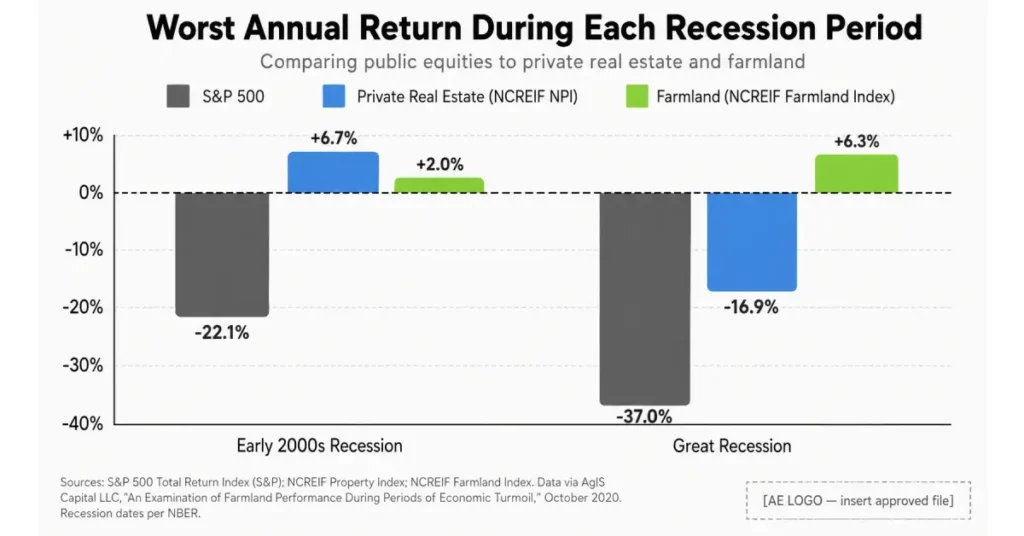
The reason is structural. Public equities are repriced every second of every trading day, so they absorb fear, headlines, and shifting expectations almost instantly. The S&P 500, for example, fell approximately 49 percent from its March 2000 peak to its October 2002 trough during the dot-com crash, and approximately 57 percent from its October 2007 peak to its March 2009 trough during the Great Recession, according to data tracked by S&P Dow Jones Indices and the Federal Reserve. Those drawdowns reflect sentiment as much as fundamentals.
This is also why a portfolio that looks diversified can fail in a downturn. When holdings are all priced on the same public exchanges and react to the same macro signals, they tend to fall together. True resilience comes from owning assets whose value is not set minute by minute by the crowd.
How Alternative Investments Perform During a Recession: What History Shows
Alternative investments during a recession have historically shown lower correlation to public equities, though performance varies widely by asset class and by the nature of each downturn. The common thread among the more resilient categories is that their returns are driven by income and real-asset fundamentals rather than by daily market sentiment.
Several long-running data sets support this directional pattern. Private real estate performance has been tracked for decades by the National Council of Real Estate Investment Fiduciaries (NCREIF), whose property index data shows that private real estate has tended to move on a different timeline than public stocks, in part because valuations are appraisal-based rather than market-quoted — a feature that academic research from Wharton’s Zell/Lurie Real Estate Center has documented extensively. Farmland returns have similarly been tracked through NCREIF farmland indexes, which institutional research, including analysis published by CAIA and tracked through NCREIF data, has consistently cited as exhibiting low correlation to equities over three decades of observation.
It is important to be precise about what this does and does not mean. Lower correlation is not the same as immunity, and past patterns are not predictions. As institutional research from organizations such as the CFA Institute and the Chartered Alternative Investment Analyst Association has noted, the diversification benefit of alternatives comes from different return drivers, not from any guarantee of positive results in a given year. The data describes tendencies across cycles, not certainties in any single one.
Which Alternative Investments Hold Up Best During a Recession?
No single alternative is the “right” answer for a recession, and each carries its own risk profile. The categories below are best understood as co-equal examples, not a ranking. What they share is a revenue source that operates at least partly independently of the public stock market.
Private Real Estate
Private real estate earns returns from rents and property-level operations rather than from a share price set each morning. Because income-producing real estate is valued on cash flow and underlying assets, historical index data has often shown it moving on a slower, smoother timeline than public equities during downturns. During the 2008 financial crisis, for example, the NCREIF Property Index declined 6.5 percent while the S&P 500 fell 37 percent, according to NCREIF and S&P data. Leases and occupancy provide a degree of contracted revenue that public stocks lack.
Infrastructure
Infrastructure assets such as toll roads, utilities, and energy systems earn revenue from usage and long-term contracts. That revenue tends to be steady and often inflation-linked, which is why infrastructure has historically been cited as relatively defensive during economic slowdowns — a characteristic documented by institutional research from managers such as ClearBridge Investments and KKR. People keep using essential services even when discretionary spending falls.
Farmland
Farmland returns are driven by crop yields, commodity demand, and land appreciation — forces tied to food consumption rather than to corporate earnings. The NCREIF Farmland Index did not record a single negative annual return between 1991 and 2019, according to analysis published by AgIS Capital using NCREIF data, reflecting the simple fact that people continue to eat through a recession.
Experiential Hospitality
Experiential or operational hospitality real estate — including destination resorts, golf, and event-driven properties — earns revenue across multiple streams such as lodging, dining, memberships, and contracted events. Booked event revenue, in particular, is often committed months in advance. As one illustration, the funds offered by Accountable Equity own properties such as Kent Island Resort in Stevensville, MD, which generate income across waterfront lodging, dining, and contracted weddings and events that are typically booked well before the operating period begins.

Kent Island Resort, Stevensville, MD — owned by the funds offered by Accountable Equity and operated by VIVÂMEE Hospitality.
What the Data Doesn’t Say: The Risks That Remain
Resilience is not the same as safety, and no honest reading of the data suggests alternatives are recession-proof. Every alternative investment carries risk, including the potential loss of principal, and historical patterns may not repeat in a future downturn.
There are also important nuances. Publicly traded REITs, for example, are technically real estate but trade like stocks and can fall with the broader market — so the “alternative” label alone is not a measure of low correlation. Private alternatives are typically illiquid, meaning capital is committed for a multi-year hold. That illiquidity is not a flaw to avoid; it is often the mechanism that allows the return opportunity to exist, because the investor is being compensated for giving up the ability to sell on a moment’s notice.
Operational quality matters too. In asset classes like experiential real estate, returns depend heavily on the operator’s ability to run a complex, multi-stream business through a downturn. A capable operator can adapt revenue and protect bookings when conditions tighten; a weaker one cannot. This is why sponsor evaluation is a core part of due diligence, not an afterthought.
How Accredited Investors Structure for a Downturn
Accredited investors tend to treat recession resilience as a question of structure, not timing. Rather than trying to predict the next downturn, they build portfolios that include assets with genuinely different return drivers, so that a bad year for equities is not automatically a bad year for everything they own. Understanding how Accountable Equity structures its private real estate offerings begins with this diversification logic.
Private real estate syndications are one common vehicle for this, allowing investors to pool capital to own assets they could not access individually. Across the portfolio, properties such as Renault Winery Resort are owned by the funds offered by Accountable Equity and operated by VIVÂMEE Hospitality. Both entities were co-founded by Josh McCallen, who serves as Chief Executive Officer of both, and Melanie McCallen, Chief Experience Officer of VIVÂMEE Hospitality — a shared leadership structure intended to align ownership and operations through every part of a market cycle.
Experiential hospitality is only one example among equals here. The broader principle holds across private real estate, infrastructure, and farmland alike: each can give a portfolio a source of return that the public stock market does not control. The goal is not to escape risk entirely — it is to make sure a single downturn does not dictate the outcome of the entire portfolio.
Tax treatment can also differ meaningfully across these asset classes, and some private real estate structures offer depreciation benefits. Because outcomes depend entirely on individual circumstances, investors should consult a qualified CPA before drawing any conclusions about their own tax position.
Frequently Asked Questions
Do alternative investments perform better than stocks during a recession?
Not always, but certain alternatives have historically shown more resilience than public equities during recessions because their returns are driven by income and real-asset fundamentals rather than daily market sentiment. Asset classes such as private real estate, infrastructure, and farmland have often exhibited lower correlation to stocks, according to data tracked by NCREIF and research published by CAIA. Lower correlation is not a guarantee of positive returns, and every investment carries risk.
Are alternative investments recession-proof?
No. No asset class is recession-proof, and alternative investments can still lose value, including the potential loss of principal. The historical case for alternatives is about lower correlation and different return drivers, not immunity from downturns. Past performance is not indicative of future results.
Why does illiquidity matter for alternative investments during a recession?
Illiquidity means private alternatives are not traded on a public exchange, so they are not swept up in the kind of market-wide, sentiment-driven selling that hits stocks during a recession. The trade-off is a multi-year hold period during which capital is committed. For many accredited investors, that constraint is the mechanism that allows the return opportunity to exist, not a penalty to avoid.
Building a Portfolio That Can Withstand a Downturn
The historical record does not promise that alternative investments will rise during a recession — but it does show that asset classes backed by real assets and operational revenue have often behaved differently than public equities when the market falls. That difference is the entire point of diversification. The goal is a portfolio whose fate is not tied to a single, correlated bet. If you want to go deeper, a sensible next step is to learn how private real estate and other alternatives fit into a recession-aware allocation, and to discuss your own situation with qualified financial, legal, and tax professionals before making any decision.
Up Next in This Series
Next: Real Estate Syndication Fees Explained: What You’re Paying For and Why It Matters