
In a GP/LP structure — short for General Partner / Limited Partner — one party manages the investment and the other provides the capital. The general partner (GP) controls all operating and strategic decisions. The limited partners (LPs) invest capital, receive returns based on a predefined structure, and do not participate in day-to-day management. This arrangement is the standard legal and economic framework behind most private real estate syndications.
If you have invested in any private real estate fund, you were almost certainly an LP. Understanding exactly what that means — and how the GP earns its economics — is fundamental to evaluating any syndication opportunity. This article explains how the GP/LP structure works, what the economics look like, and what a well-structured alignment between the two looks like in practice.

Golf Club at South River, Maryland — a destination golf and hospitality property whose assets are owned by the funds offered by Accountable Equity and operated by Vivamee Hospitality.
IN THIS ARTICLE
1. The Two Roles: What the GP Does vs. What the LP Does
2. How the GP/LP Economics Work: Preferred Returns, Waterfall, and the Promote
3. Why the GP/LP Structure Matters to Investors
4. What GP/LP Alignment Actually Looks Like — and Why It Varies
5. How AE Structures the GP/LP Relationship 6. Frequently Asked Questions
The Two Roles: What the GP Does vs. What the LP Does
The GP/LP structure divides responsibility and economic participation into two clearly defined lanes.
The General Partner (GP) is the sponsor — the individual, company, or team that identifies the investment opportunity, structures the fund, raises capital, and manages all operational and strategic decisions. The GP signs all contracts, makes all material decisions, manages the property or asset, and is responsible for investor communications and distributions. In exchange for this work and risk, the GP earns management fees and a share of profits above a certain threshold — commonly called the promote or carried interest.
The Limited Partners (LPs) are the investors. They contribute the majority of the equity capital, receive returns defined in the offering documents, and have no role in day-to-day management or operations. Their liability is generally limited to the amount they invested — hence the term “limited.” The LP position is a passive investment: returns depend on the GP’s execution, not the LP’s involvement.
| Role | Primary Function |
|---|---|
| General Partner (GP) | Identifies opportunity, structures fund, manages all operations, handles investor relations, receives management fee + promote |
| Limited Partner (LP) | Provides equity capital, receives targeted returns per the fund structure, has no management role, liability limited to invested capital |
| GP Promote / Carried Interest | GP’s share of profits above the preferred return threshold — the GP’s primary performance incentive |
| LP Preferred Return | The minimum targeted return LPs receive before the GP participates in profits — typically structured as an annual percentage of invested capital |
How the GP/LP Economics Work: Preferred Returns, Waterfall, and the Promote
The economics of a GP/LP structure are governed by a distribution waterfall — a sequential set of rules that determine how cash is distributed between GPs and LPs. Understanding the waterfall tells you when and how LPs get paid, and when the GP begins to share meaningfully in the upside.
Step 1: Return of Capital. Before any profit is distributed, investors receive their original invested capital back. Some structures distribute this throughout the hold period; others return capital at the back end through a sale or refinance.
Step 2: Preferred Return. LPs typically receive a targeted preferred return — the specific percentage varies by fund and offering — before the GP shares in any profits. The preferred return is a priority distribution to LPs; it does not guarantee performance. It is a structural protection, not an investment guarantee.
Step 3: GP Catch-Up (if applicable). Some structures include a catch-up provision in which the GP receives a larger percentage of distributions for a defined period until the GP has received its targeted share of cumulative profits. Not all structures include this step.
Step 4: Profit Split. After the preferred return has been funded, remaining profits are split between the GP and LPs according to the terms in the offering documents. The specific split varies by sponsor, asset type, and fund structure and is disclosed in each offering’s offering documents. This GP share is the promote or carried interest.
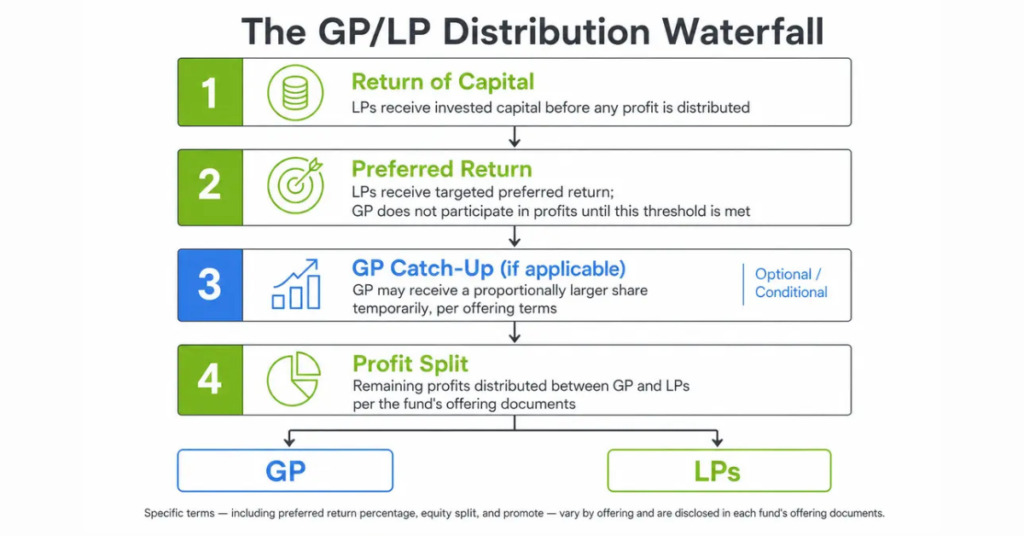
A typical GP/LP waterfall structure in a private real estate fund. Specific terms — including preferred return percentage, equity split, and promote — vary by offering and are disclosed in each fund’s offering documents.
WHY THE PROMOTE STRUCTURE MATTERS
The promote is not a fee for showing up — it is the GP’s primary economic incentive to maximize performance. A well-designed promote structure means the GP earns significantly more when LPs earn significantly more. This alignment mechanism is one of the features that distinguishes a well-structured syndication from a simple fee-driven management arrangement. When evaluating any fund, ask: at what return threshold does the GP begin to benefit from the promote, and how large is it?
Why the GP/LP Structure Matters to Investors
Most accredited investors evaluating their first or fifth syndication understand that they are LPs — but few take the time to understand the full implications of that position. Here is what matters:
- The GP structure is not just a legal formality. It determines how decisions are made, who is accountable for performance, and how the economics are divided.
- The preferred return threshold defines your floor before the GP earns upside. Understanding where that floor is — and whether it has historically been reached — is a core due diligence question.
- Management fees reduce returns regardless of performance. Understanding the fee structure — acquisition fees, asset management fees, disposition fees — is part of evaluating the total economics of the fund.
- GP alignment is not automatic. The GP earns management fees whether or not the fund performs well. The promote is the performance incentive — but only above the preferred return hurdle. A low preferred return combined with a large GP promote can misalign incentives.
- LP passivity is both a feature and a risk. You are trusting the GP to execute. Evaluating the GP’s track record, operating experience, and decision-making approach is more important in a syndication than in a public market investment.
What GP/LP Alignment Actually Looks Like — and Why It Varies
Alignment between GP and LP interests is not guaranteed by the structure itself — it is created by the specific economic terms and, critically, by the GP’s operating philosophy and commitment to the asset.
In many syndications, the GP is a financial engineer: a sponsor who sources deals, structures offerings, raises capital, and delegates management to a third-party property manager. The GP collects fees, monitors performance, and participates in the promote at exit. This is a legitimate model — but the GP’s relationship to the asset is fundamentally financial, not operational.
A different alignment model exists when the operating company and the capital-raising entity share leadership. When the person responsible for fund performance is also responsible for operational execution — and when both roles are a long-term personal and professional commitment — the alignment argument changes. The GP does not step away from the asset after capital is raised. The GP’s livelihood depends on operations performing, guests returning, and properties generating revenue.
This distinction matters most in asset classes where operations are complex. A triple-net leased retail property has limited operational variables. A destination resort with lodging, event venues, dining, recreation, and membership programs has hundreds of daily operational decisions that directly affect revenue. The GP who understands those decisions at an operational level is a structurally different partner than one who monitors them from a financial dashboard.
How AE Structures the GP/LP Relationship
Accountable Equity raises capital through private placement offerings under Rule 506(c) of Regulation D. The funds offered by Accountable Equity own the underlying resort assets. Vivamee Hospitality is the operating company that manages and runs those properties.
Josh McCallen and Melanie McCallen co-founded both Accountable Equity and Vivamee Hospitality. Josh serves as CEO of both entities; Melanie serves as Chief Experience Officer of Vivamee Hospitality. This shared leadership — both co-founders operating at the intersection of investor capital and operational execution — is a structural answer to the owner-operator misalignment that is common in syndications where fund management and property management are separate companies with separate incentives.
In certain offerings, Josh McCallen has also participated as a limited partner investor and as a personal guarantor of fund-level debt obligations — a level of personal financial commitment that is uncommon among syndication sponsors. These arrangements vary by fund and are not present in every offering; investors should review the specific offering documents for each fund to understand the exact structure and any guarantor arrangements in place for that offering.
The result is that the same leadership team responsible for investor returns is also responsible for the guest experience, staffing, event bookings, and revenue management at each property. The funds offered by Accountable Equity serve as the LP-facing capital structure; Vivamee is the operational entity that drives the performance that LPs are investing in.
WHY THE PROMOTE STRUCTURE MATTERS
The promote is not a fee for showing up — it is the GP’s primary economic incentive to maximize performance. A well-designed promote structure means the GP earns significantly more when LPs earn significantly more. This alignment mechanism is one of the features that distinguishes a well-structured syndication from a simple fee-driven management arrangement. When evaluating any fund, ask: at what return threshold does the GP begin to benefit from the promote, and how large is it?
The Bottom Line
The GP/LP structure is the operational backbone of every private real estate syndication. As an LP, you are a capital partner — you receive preferred returns and share in upside, with management responsibility sitting entirely with the GP. As a prospective investor, your job is to evaluate the GP: their track record, their operational depth, their fee structure, and how their economic incentives align with yours. A well-structured GP/LP relationship — with a clear waterfall, a meaningful preferred return, and a GP who is operationally committed to the asset — is the foundation of a sound syndication investment. Understanding this structure is the prerequisite for evaluating everything else.
Frequently Asked Questions
What is the difference between a general partner and a limited partner in real estate?
The general partner (GP) manages the investment — sourcing the deal, raising capital, handling all operations, and making all strategic decisions. The limited partner (LP) contributes capital, receives returns per the fund’s distribution structure, and plays no role in management. GP liability is generally broader; LP liability is typically limited to the amount invested.
What is a GP promote in real estate syndication?
The GP promote — also called carried interest — is the GP’s share of profits above the LP preferred return threshold. It is the GP’s primary performance incentive: the GP earns significantly more when the fund outperforms. A typical structure might give the GP 20–30% of profits above the preferred return hurdle, though the exact percentage varies by fund and offering.
Is the preferred return guaranteed?
No. A preferred return is a targeted distribution priority — LPs receive it before the GP participates in profits, but it is not guaranteed. If the fund does not generate sufficient cash flow or sale proceeds, the preferred return may not be fully funded. Any fund offering that implies otherwise warrants careful scrutiny of the underlying offering documents.