
Most physicians spend the first decade of their career building income. The second decade reveals the problem: high income, high taxes, and a portfolio that looks almost identical to what a 28-year-old with a 401(k) is holding — just with more zeros.
The math is uncomfortable. A physician earning $400,000 per year loses a significant portion to federal and state income taxes before a dollar reaches their portfolio. What remains typically flows into the same stocks, funds, and retirement accounts that make up the vast majority of high-income professional portfolios. The diversification is largely cosmetic — different funds, same underlying exposure to public equity markets.
This post is for accredited investors in the medical profession — or high-income professionals in any field who recognize this pattern — who are beginning to ask whether a different approach exists. The answer is yes, and it starts with understanding what the accredited investor designation actually unlocks.
Note: Investment opportunities offered by Accountable Equity are available only to accredited investors as defined by applicable securities laws. This content is educational. Nothing here constitutes investment, tax, or legal advice.

High-income medical professionals are among the most common accredited investors in America — and among the most underserved by conventional wealth management.
The Two Problems Physicians Rarely Solve at the Same Time
The conversation about physician wealth almost always gets split into two separate tracks: one about tax efficiency, another about portfolio diversification. Advisors who specialize in one rarely address the other. The result is that most high-income physicians are managing both problems independently — and solving neither particularly well.
The Tax Problem
A physician’s income is primarily earned income, taxed at ordinary income rates. Unlike business owners who may have more flexibility in how income is classified, most physicians in employed or group practice settings pay full ordinary income tax rates on nearly everything they earn. Retirement contribution limits provide some relief, but those limits are modest relative to physician income levels. The gap — the income above what retirement vehicles can shelter — gets taxed at the highest applicable marginal rates.
The Diversification Problem
Most physician portfolios are heavily weighted toward public equities — either through direct stock holdings or through 401(k)s and brokerage accounts that hold mutual funds and ETFs. These instruments are liquid, which feels like a virtue. But they are also correlated: when public markets decline, nearly all of the positions move in the same direction. The 2022 calendar year demonstrated this clearly — stocks and bonds fell simultaneously as both asset classes repriced in response to rising interest rates. A 60/40 portfolio offered very little protection that year.
The physicians who appear to navigate these two problems most effectively tend to have one thing in common: they have moved a portion of their capital into assets that operate outside the public market system entirely.
What Accredited Investor Status Actually Opens
The accredited investor designation exists because certain investment structures — private placements, real estate syndications, private funds — are exempt from standard SEC registration requirements. In exchange, participation is limited to investors who meet specific income or net worth thresholds, on the theory that these investors have the financial sophistication and capacity to evaluate the risks.
Current qualification thresholds (2026): $200,000 in individual income (or $300,000 joint with a spouse or domestic partner) in each of the two most recent years, with reasonable expectation of the same in the current year — or $1,000,000 in net worth, excluding primary residence.
Most attending physicians clear these thresholds. What many don’t realize is what being accredited actually unlocks: access to private real estate syndications, private equity vehicles, and structured fund investments that are not available through standard brokerage platforms. These are asset classes where institutional investors — endowments, pension funds, family offices — allocate significant capital. Individual accredited investors can now participate in the same structures.
For a deeper overview of what alternative investments are and how accredited investors access them, see our earlier post in this series.
What Private Real Estate Syndication Actually Offers Physicians
A real estate syndication pools capital from multiple accredited investors to acquire, operate, and eventually sell a property or portfolio of properties. Investors participate as limited partners — they hold an ownership interest in a real, operating asset, but bear no management responsibility.
This structure addresses both physician problems in one vehicle.
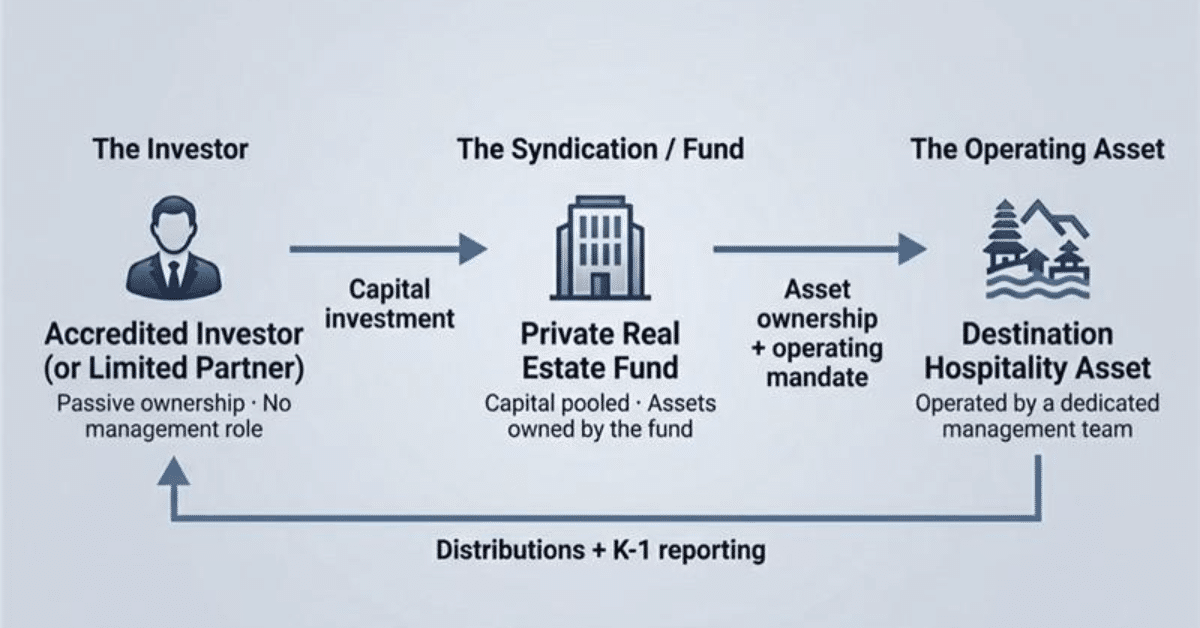
In a private real estate syndication, accredited investors hold an ownership interest in real operating assets — with no management responsibility. The fund owns the asset; a dedicated operating team runs it.
On the Tax Side
Real estate syndications can generate passive losses through depreciation — including bonus depreciation, which was permanently restored to 100% for qualified property placed in service after January 19, 2025. These depreciation allocations flow to limited partners through K-1 tax documents.
For most physicians, those passive losses cannot directly offset W-2 or 1099 earned income — that requires qualifying as a real estate professional under IRS rules, which most employed physicians will not meet. But that is not where the story ends, and stopping there misses the real benefit.
Passive losses that cannot be used immediately are not lost — they are carried forward. They accumulate year over year and can be applied against future passive income, including the distributions you receive from the syndication itself. In practice, this means a meaningful portion — and in some cases all — of the cash distributions a physician receives from a real estate syndication can come back tax-free or at significantly reduced tax rates. Compare that to a dividend, a bond coupon, or a stock gain from a public market portfolio, all of which are taxed as ordinary income or capital gains with no shelter mechanism. The carryforward structure is one of the most underappreciated advantages available to accredited investors in private real estate, precisely because most financial advisors focused on public markets never encounter it.
The specifics depend heavily on each investor’s tax situation, income classification, and how the depreciation schedule is structured at the fund level. Every physician considering this structure should work through the mechanics with a CPA who is familiar with real estate syndications before drawing conclusions about their own picture.
On the Diversification Side
Private real estate operates outside the public market cycle. It is not a ticker symbol. It does not reprice based on the Federal Reserve’s announcement schedule or a bad quarter in the S&P 500. The value of the asset is tied to its operations — what it produces, how it’s managed, and the fundamentals of the local market. That non-correlation is precisely what makes it useful as a portfolio complement.
On the Passive Income Question
A physician’s time is fully committed. The last thing a working physician needs is to manage property, field tenant calls, or make operational decisions. A well-structured private syndication requires none of that. The investor reviews the deal, makes the commitment, monitors quarterly reporting, and receives distributions — while the operating team handles everything else. The complexity of running a real operating business at scale is exactly what makes this asset class difficult to replicate and less competed-over by less sophisticated capital.
The Liquidity Trade-Off: Why It’s Different Than It Sounds
The standard objection to private real estate investments from high-income professionals is liquidity. Stocks can be sold tomorrow. A position in a private syndication has a defined hold period — typically three to seven years depending on the fund structure and investment thesis — and no ready secondary market.
For many investors, that trade-off is the wrong frame. A physician earning $400,000 annually is not typically deploying capital they will need next month. The dollars that make sense for a private placement are the dollars above what the emergency fund, near-term expenses, and liquid reserves require. Those dollars, sitting in public equities, are liquid — but they are also fully exposed to public market volatility. Moving a portion of that capital into a private structure doesn’t reduce liquidity in any meaningful operational sense; it reduces availability of a specific portion of invested capital during a defined window.
In exchange for that constraint, the investor receives an ownership stake in a real asset — something that can be visited, that employs people, that serves guests, and that generates cash from actual operations. That is a different relationship to capital than a brokerage account position. For many accredited investors who built their careers in a profession tied to real outcomes, it is a more intuitive one.
What to Look for When Evaluating a Syndication Sponsor
Accredited investor status opens the door. Sponsor quality determines whether walking through it is worth it.
The most important due diligence a physician can do before committing capital to any private syndication is not financial analysis — it is operator analysis. A financial model is only as reliable as the team executing against it. The questions that separate serious evaluation from surface-level review are about operational depth: Has this team operated this type of asset at scale? Does the same team that underwrites the deal also run it day-to-day? What is their track record in market stress conditions?
What that looks like in practice: Josh McCallen and Melanie McCallen co-founded both Accountable Equity and Vivamee Hospitality. Josh serves as CEO of both entities; Melanie serves as Chief Experience Officer of Vivamee Hospitality. Together they bring more than 50 combined years of hospitality experience. Before founding Accountable Equity, Josh served as President and Partner of Icona Resorts, where the company earned Inc. 5000 recognition three consecutive years and TripAdvisor’s #7 Best Hotel in the U.S. In 2025, both Accountable Equity and Vivamee Hospitality achieved Inc. 5000 recognition in the same year — a dual listing demonstrating that the capital formation and operating platforms are scaling in parallel. The funds offered by Accountable Equity currently hold assets across four distinct destination hospitality asset types, including Renault Winery Resort in Egg Harbor City, NJ — one of New Jersey’s most recognized event and hospitality destinations — all operated by Vivamee Hospitality.
A sponsor who manages assets through a third-party operator has a fundamentally different risk profile than a sponsor with a fully integrated operating platform — because the incentive alignment, the information flow, and the decision-making speed are all different when the GP is also the operator. That alignment is structural at Accountable Equity: the same leadership team that acquires each asset also operates it through Vivamee Hospitality, with no third-party management layer between ownership and operations.
For a complete framework on evaluating syndication sponsors, see our post on how to evaluate a real estate syndication sponsor. The criteria apply directly to any sponsor you evaluate, including in the destination hospitality space.

Renault Winery Resort, Egg Harbor City, NJ — a destination hospitality asset whose ownership is held by the funds offered by Accountable Equity and whose operations are managed by Vivamee Hospitality. Accredited investors in the Accountable Equity community are invited to visit properties like Renault during peak operations as part of their due diligence process.
For serious investors, a property visit is not a marketing event — it is due diligence. Seeing a destination hospitality asset operating at full capacity, observing the staffing, the guest volume, and the operational execution firsthand, provides information that no financial model can replicate. Accountable Equity regularly hosts its investor community at portfolio properties for exactly this reason. Learn more about Renault Winery Resort and explore what it means to own a share of an operating destination asset.
A Note on Who This Is For
This post is educational and does not constitute a recommendation, a solicitation, or an offer to sell any security. High-income professionals considering alternatives face a decision set that is highly individual — dependent on their income structure, tax situation, existing portfolio, hold period tolerance, and specific financial goals. The right first step is consulting qualified financial, legal, and tax professionals — including a CPA familiar with real estate syndications and a securities attorney familiar with private placements — and reviewing your current portfolio with fresh eyes. Not every accredited investor belongs in private real estate. But most of the physicians who arrive at Accountable Equity’s investor community say the same thing: they wish they had known earlier that this option was available to them.
Frequently Asked Questions
Are physicians automatically accredited investors?
Most attending physicians who are in their earnings years qualify as accredited investors based on income — $200,000 individual or $300,000 joint income in each of the past two years with expectation of the same this year — or on net worth of $1,000,000 excluding primary residence. Qualification is individual and should be confirmed for your specific situation.
Can physicians use real estate syndication losses to offset their medical income?
For most physicians, passive losses from real estate cannot directly offset W-2 or 1099 earned income without qualifying as a real estate professional under IRS rules — a threshold most employed physicians will not meet. However, those losses are not lost. They carry forward and can be applied against future passive income, including distributions received from the syndication. This means a physician investor may receive cash distributions that are partially or fully sheltered from tax — a significant advantage over public market income, which is taxed as ordinary income or capital gains with no equivalent offset mechanism. The exact benefit depends on your specific tax situation. Consult a CPA who is familiar with real estate syndication tax treatment to understand how the carryforward applies to your circumstances.
What is bonus depreciation, and does it apply to syndication investments?
Bonus depreciation allows investors to accelerate deductions for qualified property in the year it is placed in service, rather than spreading those deductions over the standard depreciation schedule. Congress permanently restored 100% bonus depreciation for qualified property placed in service after January 19, 2025. In a syndication, these deductions can flow to limited partners through K-1s. How meaningful they are for your tax situation is a question for your CPA — the mechanism is real; the benefit is individual.
How long is capital typically committed in a private real estate syndication?
Hold periods vary by fund structure and investment thesis, but three to seven years is a common range. Some funds have shorter windows; others may extend. Investors should review offering documents carefully and plan for capital to be illiquid for the full stated hold period.
What does ‘passive’ mean in the context of passive real estate investing?
Passive refers to the investor’s management role — limited partners in a real estate syndication have no day-to-day operational responsibility. It does not mean the investment requires no monitoring or due diligence. Reviewing quarterly reports, understanding the sponsor’s performance against projections, and staying informed about market conditions are all appropriate investor activities regardless of the passive structure.
The Bottom Line
The physicians who build meaningful wealth outside of their practice earnings tend to do one thing differently than their peers: they stop treating their accredited investor status as a credential and start using it as a key. Private real estate syndication is one of the most direct ways qualified investors can access returns tied to real operating assets, generate potential tax efficiency through depreciation, and build passive income that doesn’t require another hour of clinical work.
Neither of those outcomes — tax efficiency nor passive income — is guaranteed, and neither happens automatically. The work is in selecting the right structures with the right operators. But the category is real, it is accessible to qualified investors, and for many high-income professionals the question isn’t whether it makes sense. The question is why it took this long to look.
Josh McCallen and Melanie McCallen have built Accountable Equity and Vivamee Hospitality around exactly this model — acquiring destination hospitality assets, operating them with a fully integrated team, and inviting accredited investors to own a share of something real. To learn more, visit our investor resources section.