
Vineyard National Golf Course and Renault Winery Resort, Egg Harbor City, New Jersey — a destination hospitality and golf complex owned by Accountable Equity and operated by Vivamee Hospitality. Investment opportunities in integrated real assets like this are available exclusively to accredited investors.
Alternative investments are assets that fall outside the traditional categories of stocks, bonds, and cash equivalents. For high-net-worth individuals who have spent years building wealth through conventional market participation, alternatives represent a different approach to growing and preserving capital one that operates largely outside the daily swings of public markets.
Understanding what alternative investments are, how they work, and why sophisticated investors allocate to them is the foundation for evaluating whether they belong in your portfolio. This guide answers those questions in plain language.
Who This Content Is For
Investment opportunities in private real estate and private funds are available only to accredited investors as defined by applicable securities laws. This content is educational and is appropriate for any investor exploring these concepts. Specific investment opportunities are limited to qualifying individuals.
In This Article
- The Simple Definition: What Makes an Investment ‘Alternative’
- The Main Categories of Alternative Investments
- Why High-Net-Worth Investors Allocate to Alternatives
- The Trade-Offs: What Alternatives Require From Investors
- Private Real Estate as an Alternative Investment
- Frequently Asked Questions
The Simple Definition: What Makes an Investment ‘Alternative’
The term alternative investment refers to any asset that does not fall into the three conventional categories: publicly traded stocks, government or corporate bonds, and cash or cash equivalents. The word alternative simply means outside the mainstream — outside the daily-traded, publicly-regulated markets that most retirement accounts are built on.
Alternative investments span a wide range of asset classes. From private equity and private credit to real estate, hedge funds, commodities, infrastructure, and collectibles. What they share is not a common structure or return profile; it is what they are not: they are not publicly traded, they are not priced daily by a market exchange, and they are not accessible through a standard brokerage account.
This distinction matters more than it might seem. When an investment is not traded on a public exchange, its value is not subject to the daily emotional swings of public market sentiment. That creates both an opportunity and a constraint: opportunity because pricing can reflect fundamentals more than fear, constraint because selling quickly is rarely an option.
The Main Categories of Alternative Investments
The alternative investment universe is broad. Investors and advisors often group it into five major categories:
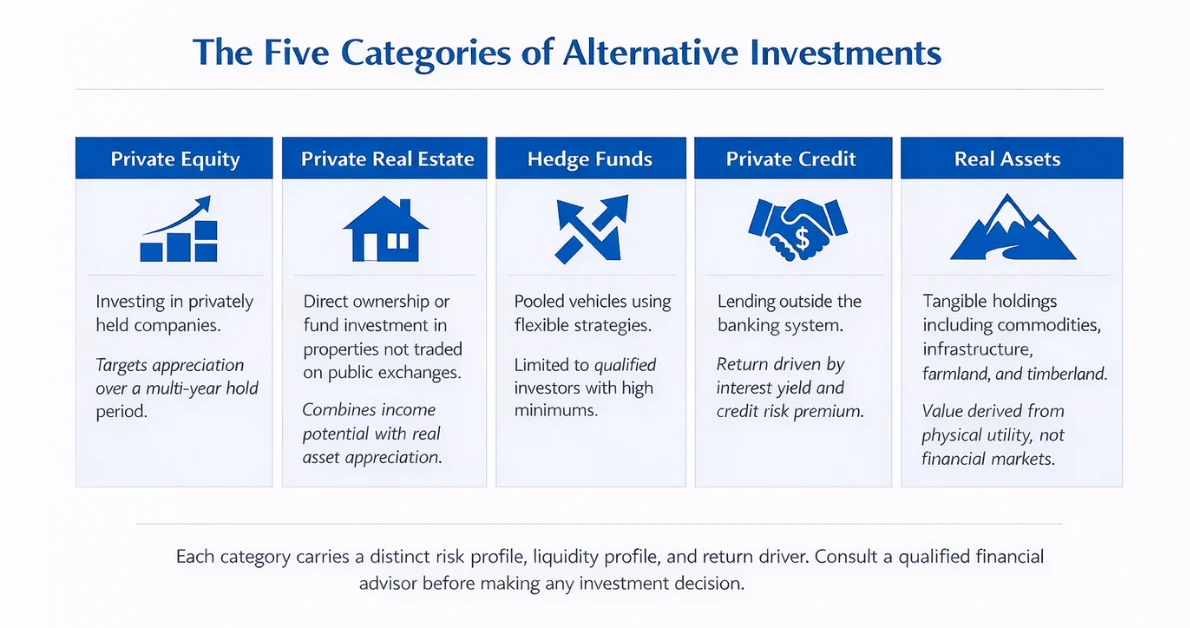
The five primary categories of alternative investments available to accredited investors. Each category carries a distinct risk profile, liquidity profile, and return driver. Consult a qualified financial advisor to determine which categories align with your portfolio goals.
Private Equity
Private equity involves investing in companies that are not publicly traded. This includes venture capital (early-stage companies), growth equity (scaling companies), and buyouts (acquiring and restructuring mature businesses). Private equity funds typically have multi-year lock-up periods and target returns that reflect the illiquidity premium investors accept.
Private Real Estate
Private real estate encompasses direct ownership of properties or investment through private funds and syndications. Unlike publicly traded REITs, private real estate is not priced daily — valuations reflect the underlying property, not market sentiment. Investments range from multifamily apartment complexes and industrial warehouses to specialized categories like hospitality, mixed-use development, and destination assets.
Hedge Funds
Hedge funds pool capital from accredited and institutional investors and deploy it across a wide range of strategies — long/short equity, global macro, arbitrage, and others. Unlike mutual funds, hedge funds face fewer regulatory constraints on their investment strategies and fee structures. Access is limited to qualified investors, and minimum investments are typically high.
Private Credit
Private credit refers to lending outside the banking system — direct loans to businesses, real estate bridge financing, mezzanine debt, and similar instruments. Private credit has grown significantly as banks have tightened their balance sheets, creating opportunities for private investors to lend and earn yield that reflects the credit risk and illiquidity they accept.
Real Assets
Real assets include physical commodities, infrastructure, timberland, farmland, and other tangible holdings. Unlike financial securities, real assets have intrinsic value derived from their physical properties and economic utility. Real estate is often classified separately from other real assets, though it shares the tangibility characteristic that many investors find appealing as an inflation hedge.
Why High-Net-Worth Investors Allocate to Alternatives
The reasons high-net-worth investors allocate to alternative investments are not uniform; different investors emphasize different benefits depending on their goals, time horizon, and risk tolerance. Several reasons come up consistently in serious portfolio conversations:
Reduced Correlation to Public Markets
Public equity and bond markets tend to move together during periods of market stress. The 2022 calendar year illustrated this clearly — a year in which both stocks and bonds declined simultaneously, producing what was widely documented as one of the worst environments for traditional 60/40 portfolios in decades. Alternative investments, particularly those tied to real assets and private credit, often behave differently from public markets. The correlation is not zero, but it is typically lower than the correlation between asset classes within the public markets.
For investors who built their wealth through public market participation, alternatives provide exposure to return drivers that are not dependent on public market sentiment.
Inflation Sensitivity
Real assets — and private real estate in particular — have historically demonstrated sensitivity to inflation. When the costs of goods and construction rise, the replacement value of existing real assets tends to rise with them. For investors concerned about long-term purchasing power erosion, real assets can play a structural role in portfolio construction. This does not mean they are immune to economic cycles, but their return drivers include factors that public equities and bonds do not capture the same way.
Illiquidity Premium
Investors in alternative investments typically accept reduced liquidity — the ability to exit quickly — in exchange for a return premium. This illiquidity premium reflects the additional risk of not being able to sell at will and the operational complexity of managing private assets. For investors who do not need immediate access to capital, accepting illiquidity has historically been associated with incrementally higher returns relative to publicly traded equivalents.
Income and Cash Flow
Some alternative investments — particularly private real estate and private credit — generate ongoing income. Rental income from properties, interest from private loans, and distributions from operating businesses can provide cash flow that is independent of public market performance. For investors in or approaching retirement, income-generating alternatives can supplement or replace traditional dividend and bond income.
Tax Treatment and Structure
Private real estate offers tax treatment that publicly traded securities cannot replicate. Depreciation — a non-cash deduction based on the property’s value over its useful life — flows through to investors and can offset passive income in the same tax year. Cost segregation studies can accelerate those deductions into earlier years, and 2025 tax legislation permanently restored 100% bonus depreciation for qualified property, allowing eligible components to be fully deducted in the year of acquisition. For investors in higher tax brackets, the after-tax return profile of a private real estate investment can look meaningfully different from its pre-tax cash flow. Tax outcomes vary significantly by individual situation — consult your CPA for advice specific to your circumstances before drawing any conclusions.
The Trade-Offs: What Alternatives Require From Investors
A serious discussion of alternative investments requires honest treatment of what they demand from investors. They are not superior to traditional investments in every dimension — they involve trade-offs that must be understood before committing capital.
- Illiquidity. Most private alternative investments have hold periods of three to ten years or longer. Investors who may need capital quickly should think carefully before allocating to illiquid vehicles.
- Due diligence burden. Public markets benefit from continuous price discovery and regulatory disclosure requirements. Private investments require investors — or their advisors — to evaluate the quality of the sponsor, the underwriting assumptions, the legal structure, and the exit strategy independently.
- Minimum investment thresholds. Most private alternative investments have minimum commitments that are substantially higher than publicly traded funds, typically starting at $25,000 to $100,000 or above.
- Accredited investor requirements. Many private investment vehicles are available only to accredited investors — individuals who meet income or net worth thresholds established by the SEC. These requirements exist because regulators have determined that investors in private securities must have the financial sophistication or cushion to absorb potential losses.
- Fee structures. Alternative investments, particularly private equity and hedge funds, often carry management fees and performance fees that are higher than those on index funds or ETFs. Fee impact on net returns matters and should be understood before investing.
A Note on Due Diligence
Alternative investments vary widely in quality, structure, and risk profile. The category label — ‘private real estate’ or ‘private equity’ — does not guarantee any particular outcome. Evaluating the specific sponsor, the asset, the deal structure, and the track record is essential. Investors should complete thorough due diligence and consult with qualified financial and legal professionals before making any investment decision.
Private Real Estate as an Alternative Investment
Within the alternative investment universe, private real estate holds a particular position for many high-net-worth investors. It combines the tangibility of a real asset land and structures that have physical existence independent of financial markets, with the potential for both income and appreciation. It also encompasses a wide range of asset types, from residential to commercial to specialized categories like hospitality, golf, and winery assets.
Private real estate investing takes several forms. Direct ownership involves purchasing and managing properties outright. Real estate investment trusts (REITs) trade on public exchanges like stocks and offer liquidity, but with the daily price volatility that comes with public market exposure. Private real estate syndications pool capital from multiple accredited investors to acquire and operate properties that would be beyond the reach of individual investors — combining the benefits of real asset ownership with the ability to participate at a scale that individual capital often cannot achieve independently.
The specific category of private real estate — what types of properties a fund targets, what the operating strategy is, and who is responsible for day-to-day management — matters as much as the asset class itself. Destination hospitality properties like resorts, golf courses, and wineries, for example, operate differently from multifamily apartments or industrial warehouses. They generate revenue through multiple channels — room rates, event bookings, food and beverage, membership programs — and their performance is tied to operational expertise as much as to real estate fundamentals.
For investors exploring private real estate as part of their alternatives allocation, our series on real estate syndication covers the structural and operational details that matter most when evaluating specific opportunities.
Frequently Asked Questions
What is the difference between alternative investments and traditional investments?
Traditional investments are publicly traded securities — stocks, bonds, and cash equivalents — accessible through standard brokerage accounts and priced daily by public markets. Alternative investments fall outside this category: they include private equity, private real estate, hedge funds, private credit, and real assets. They are typically less liquid, require higher minimums, and are often restricted to accredited investors.
Are alternative investments only for very wealthy investors?
Many alternative investments — particularly hedge funds and large private equity funds — have historically required very high minimums and been accessible only to institutional investors and ultra-high-net-worth individuals. Private real estate syndications have broader access among accredited investors, with minimums that are substantial but not exclusively within reach of the wealthiest tier. The common denominator is the accredited investor requirement: participants must meet SEC-defined income or net worth thresholds.
How do alternative investments perform compared to stocks?
Performance comparisons between alternatives and public equities are difficult because they depend heavily on the specific investment, time period, and market environment. Alternatives are generally not intended to replace public equity exposure — they are intended to complement it by adding return drivers that are not correlated to stock market performance. For individual investments, outcomes vary significantly based on the quality of the underlying asset and the sponsor managing it.
What is a real estate syndication and how does it relate to alternative investments?
A real estate syndication is a private investment structure in which a sponsor (also called the general partner) identifies, acquires, and operates a property using capital pooled from multiple accredited investors (limited partners). The syndication is a type of alternative investment — it is private, illiquid, and not traded on a public exchange. Returns are generated through property income and appreciation, distributed to investors according to the terms in the operating agreement.
Conclusion
Alternative investments offer accredited investors access to return drivers that operate outside the daily volatility of public equity and bond markets. Understanding the main categories — private equity, private real estate, hedge funds, private credit, and real assets — and the trade-offs each involves is the essential starting point for any serious portfolio conversation.
The category of alternative investments is not monolithic. What matters is not whether an investment is labeled ‘alternative’ but whether the specific asset, sponsor, structure, and risk profile align with your goals and your ability to absorb illiquidity and uncertainty. That evaluation requires time, access to quality information, and the input of qualified financial and legal advisors.
If you are exploring private real estate as part of your alternatives allocation, our content on real estate syndication mechanics and sponsor evaluation provides the foundational framework for that due diligence process.
UP NEXT IN THIS SERIES
What Is Hospitality Real Estate? An Investor’s Introduction to the Asset Class
Private real estate covers a wide range of asset types — and not all of them behave the same way. Hospitality real estate operates differently from multifamily apartments or industrial warehouses: it generates revenue through multiple streams, depends heavily on operational expertise, and tends to attract investors looking for both real asset fundamentals and experiential market tailwinds. The next post in this series examines what hospitality real estate is, how it generates returns, and what distinguishes it from other private real estate categories.
Part of the Accountable Equity Investor Education Series.