
After you wire your money into a deal, what actually happens next? A real estate syndication distribution timeline follows a structured sequence: you commit capital during a subscription period, the deal closes, the property begins operations, and — if the asset performs according to plan — you may receive your first distribution, followed by an annual tax form. None of those outcomes are guaranteed, and understanding why is just as important as understanding when they might occur. The single most common unasked question among new investors is simply this — what happens after I send the money? The honest answer is that the process moves through clear, defined stages, but each stage carries risk. The property may underperform. Distributions may be delayed, reduced, or never paid. Capital may not be returned in full. Those realities do not make syndication a poor investment — they make it an investment that rewards informed evaluation. In this article, we walk through each stage in order: the subscription period, closing, the start of property operations, your first update, distributions, the annual K-1, the hold period, and the eventual exit event.
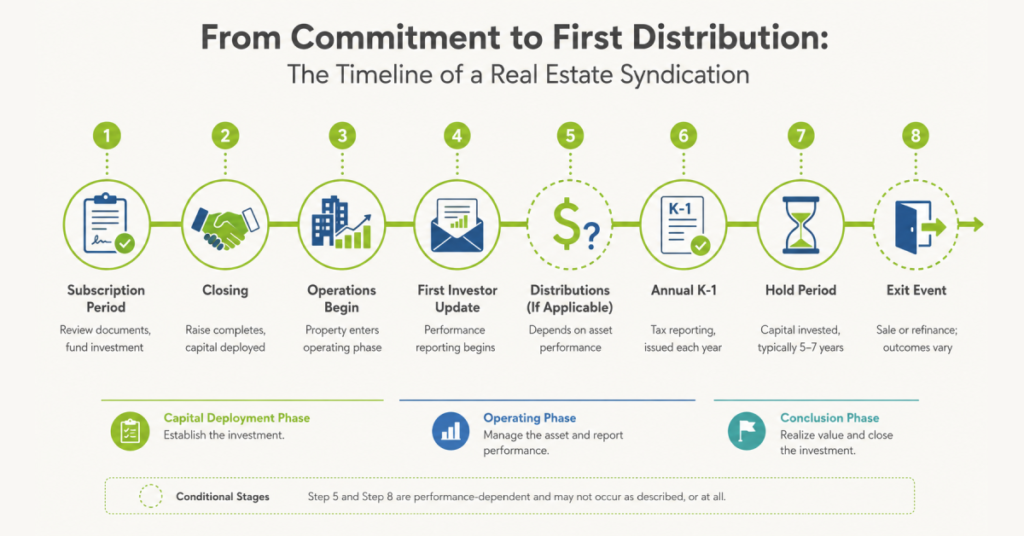
The typical stages of a real estate syndication distribution timeline, from subscription through exit. Outcomes at each stage depend on asset performance and offering terms. AI-generated image for illustrative purposes.
Accountable Equity offers investment opportunities exclusively to verified accredited investors under Rule 506(c) of Regulation D. All investors must meet applicable qualification requirements as defined by the SEC. For a detailed overview of who qualifies as an accredited investor, visit our accredited investor resource page.
In This Article
• Why the Distribution Timeline Matters Before You Invest
• What Happens Right After You Commit Capital
• From First Update to Distributions
• Taxes, Hold Period, and the Exit Event
• A Sample Real Estate Syndication Distribution Timeline
• Frequently Asked Questions
Why the Distribution Timeline Matters Before You Invest
Most hesitation about private real estate has nothing to do with the numbers. It comes from not knowing what the experience will feel like after the commitment is made. A clear real estate syndication distribution timeline answers that quietly powerful question — what happens after I wire the money? — before it ever has to be asked out loud.
Public markets train investors to expect instant feedback. You buy a stock and watch the price move the same afternoon. Private real estate works on a slower, more deliberate clock. Capital is committed for a multi-year hold, and value is built through operations rather than daily price quotes. That structural difference is what creates the opportunity — but it also means your capital is illiquid and your outcome depends entirely on how the asset and the operator perform over time.
Understanding the sequence in advance also helps you compare sponsors. When you know what a normal timeline looks like, you can ask better questions: When does the subscription period close? When might distributions begin, and under what conditions? How often are investors kept informed? Those answers tell you a great deal about how an operator runs its business — and how it handles the periods when things do not go according to plan.
What Happens Right After You Commit Capital
The early stages of a real estate syndication distribution timeline are administrative, not dramatic. Once you decide to participate, you move through a defined onboarding process before the property work even begins. Here is the typical sequence.
The Subscription Period
First comes the subscription period — the window during which the offering accepts commitments from verified accredited investors. You review the offering documents, complete your subscription agreement, verify your accredited status, and fund your investment. Subscription periods commonly run anywhere from a few weeks to several months, depending on the size of the raise. Your capital is committed but the clock on operations has not yet started.
Closing and the Start of Operations
When the raise is complete, the fund closes and the transaction is finalized. Capital is deployed into the asset, and the property formally enters the operating phase. From this point forward, the performance of the investment depends on how well the asset operates — not on market sentiment. For a destination hospitality asset such as Kent Island Resort in Stevensville, MD, this is when rooms are booked, events are hosted, and revenue streams begin contributing to performance. It is also the moment the investment shifts from paperwork to a real, operating business — one that carries real operating risk.

Kent Island Resort, Stevensville, MD — owned by the funds offered by Accountable Equity and operated by VIVÂMEE Hospitality.
From First Update to Distributions
Once operations are underway, communication and cash flow follow a rhythm — though neither is guaranteed. This is the part of the real estate syndication distribution timeline that investors most want to understand, because it addresses the practical questions: when might I start hearing back, and under what conditions might I start receiving money?
The First Investor Update
Your first update typically arrives within the first reporting cycle after closing — often a quarter or two into operations. A good update covers occupancy or usage, revenue performance, the status of any business plan milestones, and what to expect next. These reports are how a disciplined operator keeps investors informed between distributions, and consistent, transparent reporting is one of the clearest signals of a well-run sponsor. Pay attention to how the operator communicates when results are below projections — that tells you more than any highlight reel.
Distributions
Distributions are the share of operating cash flow paid out to investors — but they are not guaranteed. Whether distributions are paid, when they begin, and how much they total depend on the actual performance of the asset and the terms set forth in the offering documents. A stabilized, income-producing asset may begin distributions relatively early, while a value-add or repositioning project may reinvest cash flow first and begin distributions later. If the asset underperforms, distributions may be reduced, delayed, or not paid at all during certain periods.
It is also important to understand that profitability alone does not mean distributions will be paid. A sponsor may have valid business reasons to retain cash even when the asset is performing well — building operating reserves, funding planned capital improvements, meeting lender reserve requirements, satisfying debt covenants, or following the reinvestment provisions outlined in the offering documents. The decision to distribute is governed by the terms of the partnership agreement and the sponsor’s fiduciary obligations, not simply by whether revenue exceeds expenses in a given period.
Distribution cadence varies across the industry; some sponsors pay quarterly while others pay annually. An annual cadence is common in hospitality syndications, where seasonal revenue patterns make a full operating year a more meaningful measurement period than any single quarter. The key for any investor is to read the offering documents carefully before committing — not just to confirm distribution cadence, but to understand the conditions under which distributions may or may not be paid, and how the waterfall structure prioritizes returns.
Taxes, Hold Period, and the Exit Event
The later stages of a real estate syndication distribution timeline cover how you are taxed, how long your capital stays invested, and how the investment eventually concludes. Each of these stages carries its own considerations — and its own risks.
The Annual K-1
Each year, investors in a real estate partnership receive a Schedule K-1, the tax form that reports their share of the entity’s income, deductions, and credits. K-1s are typically issued after the close of the fiscal year, but delivery is frequently delayed. Partnership tax returns are complex, particularly when cost segregation studies or multi-entity structures are involved, and extensions are common across the industry. Investors should plan for the possibility that their K-1 may not arrive before the April personal filing deadline and that a personal tax filing extension (Form 4868) may be necessary. A delayed K-1 is a normal part of the process, not a red flag — but it is something to anticipate from the outset.
One reason real estate partnerships are attractive is that paper losses from depreciation can offset a portion of the income reported on the K-1 — but how that applies to your specific situation depends entirely on your circumstances. Always consult a qualified CPA or tax professional about how a K-1 and any depreciation benefits affect your own return.
The Hold Period
The hold period is the multi-year span during which your capital remains invested while the business plan plays out — often in the range of roughly five to seven years, though it varies by strategy. During this time, your investment is illiquid. You generally cannot sell your interest or withdraw your capital on demand. To a newcomer, that can feel like a constraint. In practice, the illiquidity premium is what creates the potential for returns that liquid public markets may not offer — but potential is the operative word. Illiquidity does not guarantee a premium. It means you are accepting a structural trade-off: you give up the ability to exit at will, and in exchange, you gain exposure to an asset class that may deliver attractive returns over time — or may not. The outcome depends on the asset, the operator, and the market.
The Exit Event
The timeline concludes with an exit event — typically a sale or refinance of the asset. At exit, capital is distributed to investors according to the partnership terms. If the asset has performed well, investors may receive their original capital plus a share of the profits. If the asset has underperformed, investors may receive less than they invested — including, in a worst-case scenario, a total loss of principal. A clear exit strategy, stated up front in the offering documents, is a hallmark of a thoughtful sponsor, but no exit strategy eliminates the risk that outcomes will differ from projections.
A Sample Real Estate Syndication Distribution Timeline
Every offering is different, and the stages below are generalized illustrations — not promises or projections for any specific fund. They show the order in which these stages tend to occur, but the outcomes at each stage depend on asset performance, market conditions, and the terms of the offering documents.
• Subscription period: commitments accepted from verified accredited investors (a few weeks to several months).
• Closing: the raise completes and capital is deployed into the asset.
• Operations begin: the property enters its operating phase and starts generating revenue.
• First investor update: usually within the first reporting cycle after closing.
• Distributions (if applicable): timing and amount depend on asset performance, reserve requirements, and offering terms. Distributions are not guaranteed, even when the asset is profitable.
• Annual K-1: issued each year after the fiscal year closes. Delivery delays are common; plan for the possibility of filing a personal tax extension.
• Hold period: capital remains invested and illiquid while the business plan plays out (often roughly five to seven years).
• Exit event: sale or refinance distributes capital according to partnership terms. Investors may receive more or less than their original investment, including a total loss of principal.
Seeing the full sequence laid out is often enough to turn an abstract worry into a manageable plan. You can learn more about how this fits into the broader picture through our investor education resources at Accountable Equity.
Frequently Asked Questions
How long until I receive my first distribution in a real estate syndication?
It depends on the business plan and on how the asset actually performs. A stabilized, income-producing asset may begin distributions relatively early, while a value-add project may reinvest cash flow first. Distributions are not guaranteed — they depend on the asset generating sufficient cash flow, and even a profitable asset may not distribute if the sponsor has valid reasons to retain cash, such as building reserves, funding capital improvements, or meeting lender requirements. Distribution cadence varies by sponsor and strategy; always review the offering documents to understand both the expected timing and the conditions under which distributions may or may not be paid.
What is a typical hold period for a real estate syndication?
Hold periods commonly fall in the range of roughly five to seven years, though the exact length depends on the strategy and the asset. During this time, your capital is illiquid — you generally cannot sell your interest or withdraw on demand. The hold period is the structural reason private real estate can offer return potential that liquid markets may not, but illiquidity also means you bear the risk of the asset underperforming over a multi-year period with no ability to exit early.
What is a K-1 and when will I receive it?
A Schedule K-1 is the tax form that reports your share of a partnership’s income, deductions, and credits. K-1s are issued each year after the fiscal year closes, but delivery is often delayed due to the complexity of partnership accounting. Investors should plan for the possibility of filing a personal tax extension. Because tax treatment depends on your individual situation, you should review your K-1 with a qualified CPA or tax professional.
Putting the Timeline to Work
The path from commitment to exit follows defined stages: subscribe, close, operate, report, distribute if performance and partnership terms support it, file the annual K-1, hold, and exit. Understanding that order in advance does not eliminate risk — real estate syndication investments can result in the loss of some or all of your principal, and distributions are never guaranteed. What the timeline does is give you a framework for asking the right questions and evaluating any sponsor against a clear standard. Informed investors do not expect certainty. They expect transparency, discipline, and the ability to evaluate an offering with their eyes open. If you would like to go deeper, explore our investor education resources to learn how the pieces fit together before you ever evaluate a single offering.
UP NEXT IN THIS SERIES Next:
How Pharmacists and Pharmacy Owners Build Wealth Through Passive Real Estate