
Investments that don’t correlate with the stock market are assets whose returns are driven by something other than the daily swings of public equities — private real estate, farmland, infrastructure, private credit, and experiential or operational real estate among them. The reason this matters is simple: most portfolios that look diversified are not. Owning ten different stocks, a few sector funds, and a target-date 401(k) feels spread out, but those holdings tend to rise and fall together because they all track the same underlying economic cycle. True diversification requires assets with different revenue drivers and different risk profiles, not more versions of the same bet. This article explains what correlation really means, which asset classes move independently of equities, what makes an asset genuinely non-correlated, and how accredited investors think about building a portfolio that does not live or die with the market.
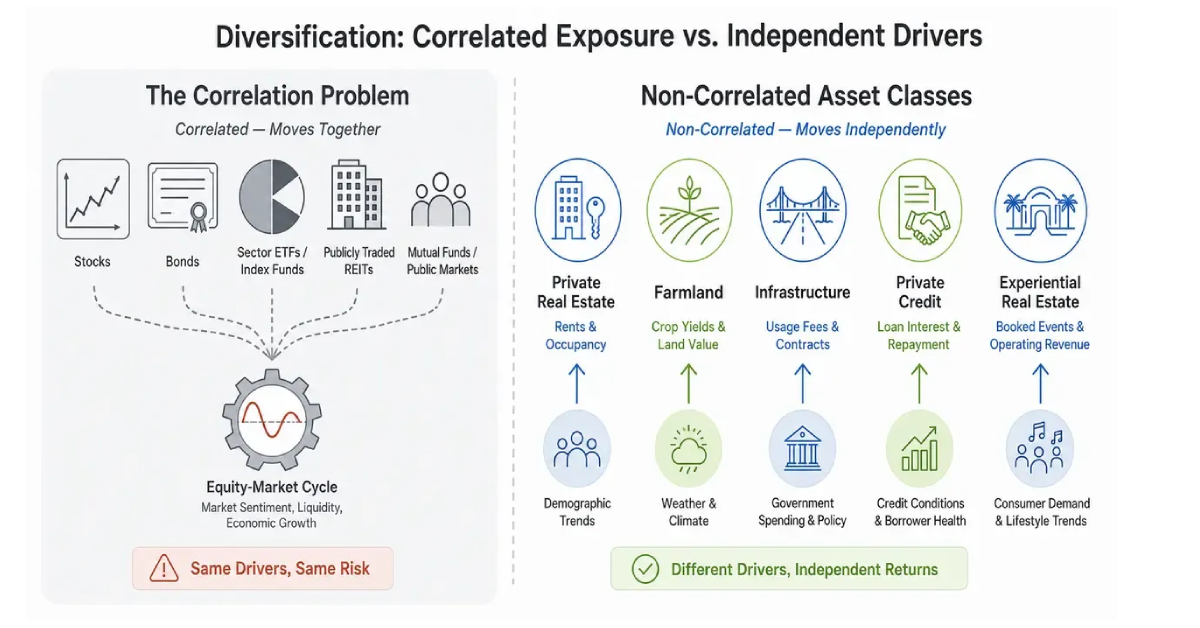
True diversification means owning asset classes driven by different forces — not variations of the same equity-market bet.
Accountable Equity offers investment opportunities exclusively to verified accredited investors under Rule 506(c) of Regulation D. All investors must meet applicable qualification requirements as defined by the SEC. For a detailed overview of who qualifies as an accredited investor, visit our accredited investor resource page.
In This Article
- What “Correlation” Actually Means for Your Portfolio
- Why Most “Diversified” Portfolios Are One Bet in Disguise
- Asset Classes That Don’t Correlate with the Stock Market
- What Makes an Asset Truly Non-Correlated?
- How Accredited Investors Build Around Non-Correlation
- Frequently Asked Questions
What “Correlation” Actually Means for Your Portfolio
Correlation measures how closely two investments move in the same direction at the same time. When two assets are highly correlated, they tend to rise together and fall together. When they are non-correlated, the performance of one tells you little about the other.
This is the heart of diversification. The goal is not simply to own more things — it is to own things that respond to different forces. A portfolio of assets that all react to the same interest-rate decision, the same earnings season, and the same investor sentiment is concentrated, even if it holds hundreds of positions.
Investments that don’t correlate with the stock market are valuable precisely because they are governed by different drivers: lease contracts, crop cycles, toll volumes, loan repayments, or booked event revenue. When equities sell off, those drivers do not automatically follow.
Why Most “Diversified” Portfolios Are One Bet in Disguise
Many investors assume they are diversified because they hold a mix of large-cap funds, growth stocks, and an index or two. In practice, these are variations of the same exposure. They are all priced daily on public exchanges, all sensitive to the same macro signals, and all tend to move together when the market turns.
The 2008 financial crisis and the 2020 selloff both showed how quickly seemingly different stock holdings can become a single correlated trade. When fear takes over, the spread between sectors narrows and almost everything in the public-equity bucket falls at once. Bonds help, but a portfolio that pairs stocks with bonds is still a portfolio built around two responses to the same rate environment.
Real diversification means stepping outside that cycle entirely. That is why a growing number of accredited investors are studying alternatives — and why understanding how Accountable Equity structures its private real estate offerings begins with understanding the diversification problem these assets are meant to solve.
Asset Classes That Don’t Correlate with the Stock Market
Several established asset classes have return drivers that operate independently of public equities. None is the single “right” answer — each carries its own risk profile, and they are best understood as co-equal tools, not a ranking. The point is that their revenue sources differ from one another and from the stock market.
Private Real Estate
Private real estate generates returns from rents, occupancy, and property-level operations rather than from a share price set by the market each morning. Because valuations are tied to income and underlying assets, private real estate often moves on a different timeline than equities.
Farmland
Farmland returns are driven by crop yields, commodity demand, and land appreciation. These factors respond to weather, agriculture cycles, and food consumption — forces largely disconnected from quarterly earnings reports.
Infrastructure
Infrastructure assets such as toll roads, utilities, and energy systems earn revenue from usage and long-term contracts. That revenue tends to be steady and inflation-linked, which is why it often behaves differently from the broader market.
Private Credit
Private credit produces income from interest payments on loans made directly to businesses. Its performance depends on borrower repayment and underwriting quality, not on the day-to-day mood of public markets.
Experiential and Operational Real Estate
Experiential or operational real estate — including hospitality, golf, and event-driven properties — earns revenue across multiple streams such as lodging, dining, memberships, and contracted events. Booked event revenue, in particular, is often committed months in advance, giving it a revenue rhythm independent of equity-market sentiment.

Renault Winery Resort, Egg Harbor City, NJ — owned by the funds offered by Accountable Equity and operated by VIVÂMEE Hospitality.
What Makes an Asset Truly Non-Correlated?
Not every alternative investment is genuinely independent of the stock market. Publicly traded REITs, for example, are technically real estate but trade like stocks and often move with the market. The label “alternative” is not a guarantee of low correlation.
Three features tend to separate investments that don’t correlate with the stock market from those that only appear to:
- A different revenue driver. Returns come from rents, yields, usage, interest, or booked events — not from share-price movement.
- A different valuation mechanism. The asset is priced on income and fundamentals rather than repriced every second by public sentiment.
- A different liquidity profile. Private holdings are not traded on an exchange, so they are not swept up in market-wide selling. The trade-off is a multi-year hold period, which is the mechanism that allows the return opportunity to exist rather than a penalty to avoid.
This is also where operational quality matters. In asset classes like experiential real estate, returns depend heavily on the operator’s ability to manage complex, multi-stream businesses. A strong operator can make the difference between an asset that holds up in a downturn and one that does not.
How Accredited Investors Build Around Non-Correlation
Accredited investors approach diversification as a question of structure, not just quantity. Rather than adding more public-market positions, they allocate across asset classes with genuinely different drivers — and they accept reduced liquidity in exchange for exposure that does not track the market tick by tick.
This is the model behind private real estate syndications, where investors pool capital to own assets they could not access individually. As one illustration, the funds offered by Accountable Equity own properties such as Renault Winery Resort in Egg Harbor City, NJ, which are operated by VIVÂMEE Hospitality. Both Accountable Equity and VIVÂMEE Hospitality were co-founded by Josh McCallen, who serves as Chief Executive Officer of both, and Melanie McCallen, Chief Experience Officer of VIVÂMEE Hospitality.
Experiential real estate is only one example among equals. The broader principle holds across farmland, infrastructure, and private credit alike: each gives a portfolio a source of return that the stock market does not control. The aim is a portfolio where a bad year for equities is not automatically a bad year for everything you own.
Tax treatment can also differ meaningfully across these asset classes, and some private real estate structures offer depreciation benefits. Because outcomes depend entirely on individual circumstances, investors should consult a qualified CPA before drawing any conclusions about their own tax position.
Frequently Asked Questions
What investments don’t correlate with the stock market?
Investments that don’t correlate with the stock market include private real estate, farmland, infrastructure, private credit, and experiential or operational real estate. Each earns returns from drivers — such as rents, crop yields, usage fees, loan interest, or booked events — that operate independently of public-equity prices.
Why is non-correlation important for diversification?
Non-correlation is important because it determines whether your holdings can fall together in a single downturn. A portfolio of assets that all respond to the same economic cycle is concentrated, even if it holds many positions. Adding genuinely non-correlated assets reduces the chance that one market event affects everything you own at once.
Are alternative investments always non-correlated with stocks?
No. Some alternatives, such as publicly traded REITs, trade on exchanges and often move with the broader market. True non-correlation depends on the asset having a different revenue driver, a different valuation mechanism, and a different liquidity profile — not simply on being labeled “alternative.”
Building a Portfolio That Doesn’t Live or Die With the Market
True diversification is not about owning more — it is about owning differently. Investments that don’t correlate with the stock market draw their returns from independent forces, which is what allows a portfolio to hold up when equities do not. Private real estate, farmland, infrastructure, private credit, and experiential real estate each offer that independence in a different form, and no single one is the universal answer.
If you are exploring how non-correlated assets might fit a long-term strategy, the next step is education, not action. Learn how these asset classes work, understand the trade-offs, and review our accredited investor resource page to see who qualifies and what accredited investors can access.
Up Next in This Series
Next: From Commitment to First Distribution: The Timeline of a Real Estate Syndication.