
Golf course real estate investment is being repriced by institutional capital at a pace the sector has not seen in decades. In April 2026, KSL Capital Partners agreed to acquire Invited Clubs — the largest owner and operator of golf clubs in the United States, with more than 150 properties and 300,000 members — for approximately $3 billion including debt. That transaction followed Arcis Golf’s growth to an enterprise value between $1.5 billion and $2 billion across 70 courses, and a late-2025 transaction valuing Topgolf at approximately $1.1 billion in a deal giving Leonard Green & Partners a 60% controlling stake. The debate about whether golf course assets belong in an institutional portfolio is effectively over. The question that remains is what separates operators who can execute at this level from those who will destroy the acquisition premium before the first full operating year.
Investment opportunities referenced in this article are available only to accredited investors as defined by applicable securities laws.
In This Guide
• Supply Contraction Meets Demand Expansion: The Structural Tailwind
• The Three-Stream Revenue Model and Why Conventional Metrics Miss the Full Picture
• Why Vertical Integration Is the Defining Operator Selection Criterion
• What Experienced Investors Evaluate in a Golf Course Syndication
• Frequently Asked Questions
Supply Contraction Meets Demand Expansion: The Structural Tailwind Behind Golf Course Real Estate Investment
The investment thesis for golf course real estate rests on a supply-demand imbalance that has been building for nearly two decades. According to the National Golf Foundation’s 2025 Graffis Report, on-course golf participation reached 28.1 million in 2024 — the highest level since 2008 and the seventh consecutive annual increase. The 1.8 million golfer increase from 2023 to 2024 was the largest single-year jump since 2000. Total rounds played hit a record 545 million, the fifth straight year above the 500 million threshold.
On the supply side, the picture is the inverse. The U.S. golf market experienced a sustained building boom from the mid-1980s through the early 2000s that created oversupply in many markets. The correction that followed was severe: course closures peaked at nearly 280 eighteen-hole equivalents in 2019. But that correction has now largely run its course. Annual closures fell to approximately 90 eighteen-hole equivalents in 2024 — the fewest in twenty years. Meanwhile, new openings and course resurrections have increased, bringing net supply change close to zero for the first time since the correction began.
For investors, this convergence creates a structural tailwind. Rising demand against stable-to-declining supply means that well-positioned golf assets are generating more rounds, more event bookings, and more food and beverage revenue per available square foot than at any point in recent memory. Critically, new supply is not coming. Building an 18-hole championship golf course from scratch now costs $8 million to $40 million or more before land acquisition, and the entitlement process for 150+ acres of recreational land near major metro areas can take years. That replacement cost floor is the mechanism that protects existing operators from the kind of competitive new-build pressure that compresses returns in asset classes like multifamily and self-storage.
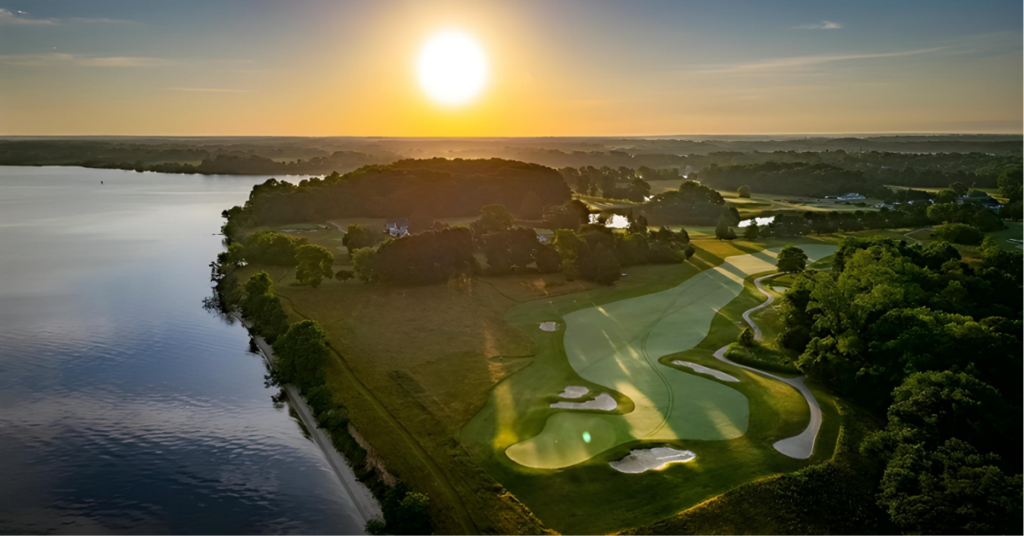
Queenstown Harbor Golf Resort, Queenstown, MD — owned by the funds offered by Accountable Equity and operated by VIVÂMEE Hospitality.
The Three-Stream Revenue Model and Why Conventional Metrics Miss the Full Picture
One reason institutional investors have historically underweighted golf course real estate is that conventional hotel metrics make these assets look worse than they are. ADR (average daily rate) and RevPAR (revenue per available room) measure only the lodging component of a property’s income. For a single-use hotel, those are the relevant metrics. For a golf-anchored destination property generating revenue across membership, public play, food and beverage, contracted events, lodging, and ancillary services simultaneously, they capture a fraction of the actual revenue model.
The appropriate framework is TRevPAR — total revenue per available room — which aggregates all operating revenue streams into a single performance metric. When investors underwrite a golf course asset using TRevPAR rather than RevPAR, the revenue picture changes materially. A property that looks like a mediocre hotel on a RevPAR basis may be a high-performing multi-stream operating business on a TRevPAR basis. This analytical distinction is not academic. It directly affects acquisition pricing, operating projections, and the return profile investors should expect.
The three primary revenue streams in a well-operated golf course asset are golf operations (membership dues, public play fees, tournament hosting), food and beverage (restaurant, catering, bar operations), and contracted events (weddings, corporate retreats, and private functions). The event revenue stream deserves particular scrutiny because it behaves differently from the other two. Weddings book 12–18 months in advance, creating forward revenue visibility that virtually no other real estate asset class can replicate. Corporate retreat contracts are negotiated and signed months before the event date. This contracted, pre-committed revenue does not evaporate when consumer confidence weakens or equity markets decline — a structural protection that is difficult to find in conventional real estate.
The interaction between these three streams is where the operating leverage lives. A golf course that generates only greens fees is a fragile single-stream business. A golf course that also hosts hundreds of weddings annually, operates a year-round restaurant, and contracts corporate retreat packages is a diversified operating platform. The second model can absorb a soft golf season or a weather disruption because the event pipeline was contracted long before conditions changed. This is not a theoretical distinction — it is the difference between golf courses that failed during the 2006–2019 correction and the ones that institutional capital is now acquiring at multi-billion-dollar scale.
Why Vertical Integration Is the Defining Operator Selection Criterion in Golf Course Real Estate
The consolidation wave in golf course real estate reveals a pattern that experienced syndication investors should study carefully. The acquirers writing the largest checks — KSL, Arcis, TPG through Troon — are not passive capital allocators buying stabilized yield. They are operating platforms acquiring complex, labor-intensive hospitality businesses and installing their own management infrastructure. The distinction matters because it illuminates the single most important due diligence question in any golf course syndication: does the sponsor actually operate the asset, or do they outsource management to a third party?
Golf course operations require large seasonal workforces, active revenue management across multiple streams, continuous capital reinvestment in course conditions and clubhouse facilities, and relentless execution on guest experience standards. A property hosting weddings, public play, and membership programming on the same weekend is managing three distinct hospitality experiences simultaneously, each with its own service expectations and failure modes. The staffing scale alone is a disqualifying barrier for most operators: hundreds of full-time, part-time, and seasonal employees across food and beverage, grounds maintenance, event coordination, pro shop operations, and guest services.
When ownership and operations are separated — as they are in most third-party-managed hospitality structures — the misalignment between the capital partner’s objectives and the operator’s incentives creates friction that erodes value. The management company optimizes for its fee. The ownership entity optimizes for returns. Those objectives diverge most sharply during capital reinvestment decisions, seasonal staffing levels, and event pricing strategy — exactly the decisions that determine whether a golf course asset performs at institutional quality or deteriorates. This is why how a sponsor structures its offerings is as important as the asset it acquires. When the same leadership team that raises capital and acquires the property also operates it through a vertically integrated model, the alignment between investor capital and operating decisions is structural, not contractual.
What Experienced Investors Evaluate in a Golf Course Real Estate Syndication
For accredited investors evaluating golf course real estate through a syndication structure, the operator’s track record across several specific dimensions matters more than the asset’s curb appeal. Experienced syndication investors already know how to read a pro forma and assess a capital structure. What distinguishes golf course due diligence from conventional real estate evaluation is the weight that operating capability carries relative to deal terms.
Staffing depth and hospitality leadership
Ask how many hospitality professionals the sponsor has hired, trained, and managed across their career. A sponsor who has led thousands of hospitality employees across multiple properties operating simultaneously has navigated the seasonal ramp-up, training, and service culture challenges that will determine whether the asset performs. A sponsor whose experience is limited to asset-light real estate — multifamily, self-storage, industrial — has not encountered these failure modes and will not see them coming. Josh McCallen and Melanie McCallen, who co-founded Accountable Equity and VIVÂMEE Hospitality, bring a combined 50+ years of hospitality operating experience, including leading 3,000+ hospitality professionals across Icona Resorts and the VIVÂMEE portfolio since 2010.
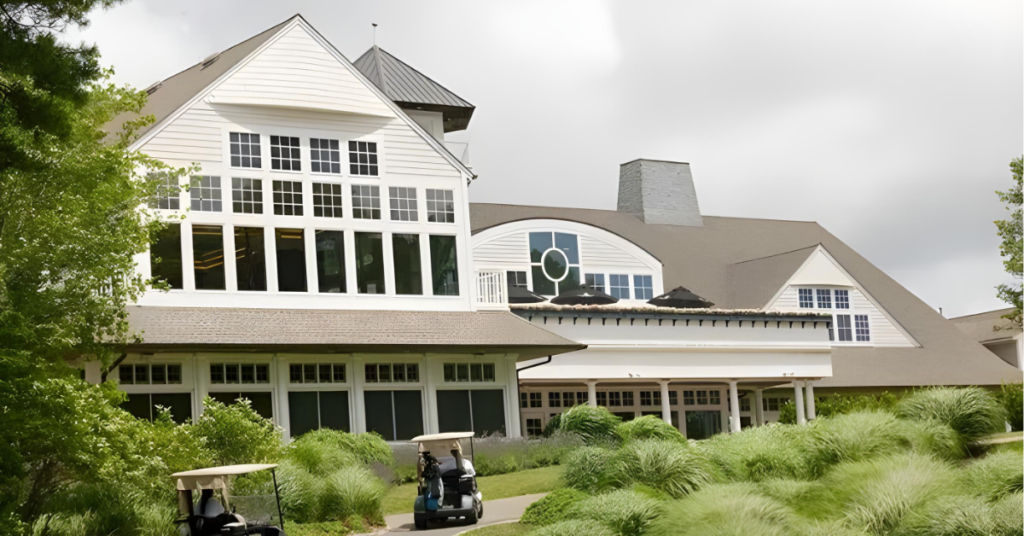
LBI National Golf & Resort, Little Egg Harbor, NJ — owned by the funds offered by Accountable Equity and operated by VIVÂMEE Hospitality.
Revenue stream diversification and forward visibility
Evaluate whether the asset generates revenue from three or more distinct streams and whether any of those streams are forward-contracted. A golf course with a membership base, active public play, and a contracted event pipeline spanning 12–18 months forward is a fundamentally different risk profile from a course that depends primarily on daily greens fees. The LBI National Golf & Resort model in Little Egg Harbor, New Jersey, illustrates this: golf operations, catering, restaurant, lodging, and event programming operate as complementary revenue engines on 155 acres serving the Long Beach Island and Jersey Shore markets. Queenstown Harbor Golf Resort in Queenstown, Maryland, applies the same three-stream framework at a different scale — 710 acres, two championship courses, and revenue diversified across golf, weddings and events, resort lodging, and corporate retreats, serving the Baltimore, Washington D.C., and Annapolis drive markets.
Replacement cost basis
Determine the relationship between the sponsor’s acquisition basis and what it would cost to rebuild the asset from scratch. When renovation costs alone for championship-caliber courses now routinely reach $10 million to $20 million — and a full new build including land, construction, clubhouse, and irrigation can exceed $40 million — acquiring an existing, operating asset at a fraction of that replacement cost creates a structural margin of safety that purely financial underwriting does not capture. This is the barrier to entry that keeps new competitive supply from eroding existing operators’ market position.
Frequently Asked Questions About Golf Course Real Estate Investment
How has institutional capital changed the golf course acquisition landscape?
The last 18 months have seen a marked acceleration of institutional activity in golf course real estate. KSL Capital Partners’ approximately $3 billion acquisition of Invited Clubs (150+ properties) and Arcis Golf’s growth to an enterprise value estimated between $1.5 billion and $2 billion across 70 courses are representative of a broader trend: private equity and institutional hospitality platforms are consolidating fragmented golf portfolios at scale. This consolidation is compressing the window for smaller, operationally capable sponsors to acquire quality assets below replacement cost — which is one reason experienced investors are evaluating golf-focused syndications now rather than waiting for the next cycle.
What metrics should investors use to evaluate golf course asset performance?
TRevPAR (total revenue per available room) is the preferred metric because it captures all operating revenue streams — golf, food and beverage, events, lodging, membership — rather than isolating the room component the way ADR and RevPAR do. For assets without a lodging component, total revenue per available hole or revenue per available acre can serve as comparable benchmarks. The critical analytical principle is the same: any metric that measures only one revenue stream in a multi-stream operating business will systematically understate the asset’s true performance and mislead acquisition underwriting.
Is golf course real estate investment suitable for a passive syndication investor?
Golf course assets are among the most operationally intensive properties in real estate, but the syndication structure is specifically designed to let limited partners participate in this asset class without management responsibility. The key is sponsor selection. The same operational complexity that makes golf course assets difficult to manage directly is what creates the return opportunity for investors who select a vertically integrated sponsor with genuine hospitality operating experience. Investors should conduct thorough due diligence on the sponsor’s staffing track record, event execution history, and the alignment between ownership and operations before committing capital.
The Bottom Line
Golf course real estate investment has moved from the margins of institutional portfolios to the center of a multi-billion-dollar consolidation cycle. The supply-demand fundamentals — record participation, declining course closures, and prohibitive replacement costs — are structural, not cyclical. But the asset class rewards operational execution more severely than any other real estate sector. Investors who allocate to golf course real estate through sponsors without genuine hospitality operating depth are not capturing the opportunity — they are financing someone else’s education.
For accredited investors who understand that complexity is not a defect but the mechanism that creates the opportunity, golf course real estate offers an allocation that is both defensible and differentiated. The evaluation starts with the operator, not the asset — and Accountable Equity’s investor resources section is a place to continue that evaluation.