
Returns in experiential real estate investments are driven by a fundamentally different engine than conventional real estate. Understanding that engine — and why it rewards operational excellence while penalizing passive ownership — is the core of how sophisticated investors underwrite this asset class correctly.
Most real estate investors enter the category with a mental model built on multifamily or commercial assets: buy a property, manage occupancy, collect rent, benefit from appreciation. That model does not transfer. The return drivers in destination hospitality are structural, layered, and operationally intensive. They create a moat for capable operators that other asset classes cannot replicate — and they punish investors who treat them like real estate when they are something closer to an operating business.
This post explains what those drivers are, how they interact, and why the metrics most investors use to evaluate hospitality miss the most important part of the picture.
Investment opportunities offered by Accountable Equity are available only to independently verified accredited investors through offerings made in accordance with Rule 506(c) under Regulation D of the Securities Act of 1933.
IN THIS ARTICLE
Why Conventional Real Estate Metrics Don’t Apply
The Multi-Stream Revenue Model
Contractual Event Revenue as a Return Stabilizer
Why Operational Depth Is the Moat
How to Evaluate an Experiential Real Estate Investment
Frequently Asked Questions
Why Conventional Real Estate Metrics Don’t Apply
When institutional investors evaluate a hotel, they typically lead with ADR (average daily rate) and RevPAR (revenue per available room). These are the standard benchmarks for lodging performance, widely used by analysts, lenders, and operators across the conventional hospitality sector.
The problem is that both metrics measure only one revenue stream: room revenue. For a standard limited-service hotel that generates the majority of its income from occupied rooms, ADR and RevPAR are adequate proxies for overall performance.
For a destination hospitality property operating across rooms, events, food and beverage, golf, memberships, vineyard and wine experiences, and agri-tourism, ADR and RevPAR systematically understate true performance. A property running 13 wedding events across a single Thursday-Sunday weekend is generating contracted revenue across dozens of service categories simultaneously. None of that appears in RevPAR.
The correct metric for this asset class is TRevPAR — total revenue per available room. TRevPAR captures the full revenue picture: every dollar generated per available room across every operating stream, not just lodging. It is the metric that reflects how destination hospitality properties are actually underwritten by operators who understand them.
ADR is worth understanding as a baseline. RevPAR adds occupancy context. TRevPAR is the number that tells you whether the operator is extracting full value from the asset. Investors evaluating experiential real estate who do not work from TRevPAR are evaluating an incomplete picture.
The Multi-Stream Revenue Model
The return potential of experiential real estate is inseparable from its revenue architecture. A destination hospitality property does not have a single revenue stream. It has many, and the interaction between those streams is what creates the performance ceiling that conventional real estate cannot approach.
Consider what a well-operated destination resort generates in a peak operating weekend:
- Room revenue from hotel occupancy across multiple room types and rate categories
- Food and beverage revenue from multiple dining venues, catering for events, and in-room service
- Event revenue from contracted weddings, corporate functions, and private celebrations
- Golf revenue from membership, public play, and event-hosted rounds
- Vineyard and wine experience revenue from tastings, tours, and wine sales where applicable
- Membership and recurring revenue from loyalty programs, golf memberships, and venue memberships
- Agri-tourism and ancillary revenue at farm and nature-based properties
The Vivamee Hospitality portfolio — which operates the resort assets owned by the funds offered by Accountable Equity — hosts over 320,000 guests annually across four distinct property types. Renault Winery Resort in Egg Harbor City, New Jersey, alone has approximately 26 rentable areas on property and the capacity to run up to 13 events across a single Thursday-Sunday operating window at peak.
That is not a hotel. It is a multi-stream operating business that requires a different underwriting framework, a different staffing model, and a different kind of operator to execute at that scale. The revenue complexity is the moat.
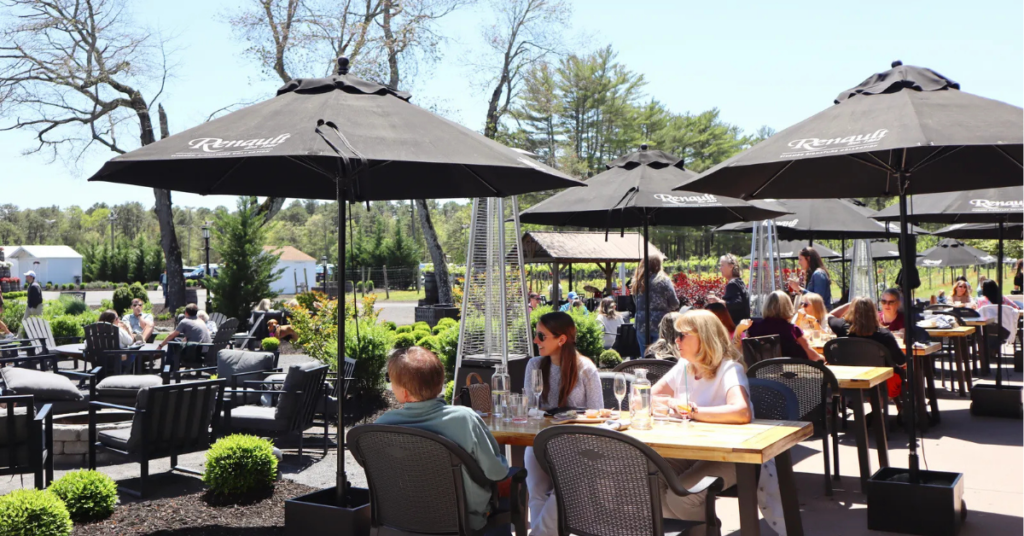
Outdoor dining at Renault Winery Resort, Egg Harbor City, NJ. Food and beverage revenue operates simultaneously with lodging, events, and vineyard and wine experiences — a multi-stream model that TRevPAR captures and RevPAR does not. The funds offered by Accountable Equity own the asset; Vivamee Hospitality operates it.
Contractual Event Revenue as a Return Stabilizer
Destination hospitality real estate has a return characteristic that most investors in other asset classes have never encountered: forward-contracted revenue from events booked 12 to 18 months in advance.
Weddings are the clearest example. A couple booking their wedding at a destination resort does not cancel because the equity markets drop 20% in the fourth quarter. A contracted corporate event does not reschedule because consumer confidence weakens. These are life events and business commitments with specific dates, signed contracts, and non-refundable deposits. They create revenue visibility that no other hospitality asset class and very few real estate categories can match.
This is a structural advantage that changes the risk profile of the investment in a meaningful way. When leisure travel contracts in a downturn — as it did in 2020 — contractual event revenue continues to hold. The 2020 operating experience at Renault Winery Resort is the most direct evidence available: the property never closed, created outdoor dining capacity rapidly, held an Independence Day event while competitors were dark, and, to the best of available knowledge, rescheduled rather than lost the majority of contracted wedding bookings. That is not a Covid survival story. It is an operator execution story.
For investors evaluating return stability and preferred return coverage, the forward booking window is the dimension that distinguishes experiential real estate from conventional hospitality assets. A property running a strong event calendar 12 months forward has a fundamentally different risk profile than one dependent on transient leisure travel bookings made within days of arrival.
The question to ask any experiential real estate sponsor is not just what the current occupancy is — it is what the contracted event revenue looks like 12 months out.
Why Operational Depth Is the Moat
The return ceiling in experiential real estate is set by the operator. This is not a passive asset class. The complexity of running a multi-stream destination property the staffing depth, the event execution systems, the guest experience standards, the logistics of managing multiple contracted events simultaneously, is not learnable from a real estate model. It is built through years of actual execution.
This operational complexity creates the competitive moat that protects investor returns. A new entrant to the destination hospitality space cannot replicate a seasoned operator’s event execution capability, staffing depth, or systems by acquiring a similar property. They can acquire the asset. They cannot acquire the operating platform.
Josh McCallen and Melanie McCallen co-founded both Accountable Equity and Vivamee Hospitality. Josh serves as CEO of both entities; Melanie serves as Chief Experience Officer of Vivamee Hospitality. Their combined track record spans 25-plus years in hospitality operations, including Josh’s tenure as President and Partner at ICONA Resorts — which achieved Inc. 5000 recognition three consecutive years and a TripAdvisor #7 Best Hotel in the U.S. ranking in 2017 — and Melanie’s demonstrated ability to walk a distressed property, identify its authentic potential, and transform it without imposing an external vision.
Both Accountable Equity and Vivamee Hospitality achieved Inc. 5000 recognition in 2025, a dual listing demonstrating that the capital formation and operating platforms are scaling in parallel. That parallel scaling is itself an investment signal: the operator’s growth is not running ahead of their operating capacity, or behind it.
The structural model matters here. The funds offered by Accountable Equity own the resort assets. Vivamee Hospitality operates them. The same leadership team that developed each asset also operates it. That alignment eliminates the misalignment between ownership and management that undermines most third-party-managed hospitality investments — and it is a direct return driver, not a structural nicety.

The Reindeer Run 5K at Renault Winery Resort, Egg Harbor City, NJ — a ticketed experiential event illustrating the breadth of revenue programming that extends beyond rooms, dining, and contracted private events. Operational scale at a destination resort means multiple guest experiences running simultaneously across the same property.
How to Evaluate an Experiential Real Estate Investment
The criteria for evaluating an experiential real estate investment are not fundamentally different from the criteria used to evaluate any real estate syndication sponsor — but the evidence required to satisfy them is.
Experienced Syndication Investors and Sophisticated Investors applying their existing due diligence framework to this asset class should expect to verify the following:
- Operating track record across multiple property types. A single property is a data point. A replicable operating system applied across winery resorts, waterfront boutique properties, golf resorts, and working farm event venues is a platform.
- Revenue stream diversification. How many streams are operating, and what is the relative contribution of each? Concentrated dependence on a single revenue category is a vulnerability.
- Forward booking visibility. What does contracted event revenue look like 12 months out? This is the stabilizer. Operators who cannot answer this question with specificity are not running a destination hospitality business — they are running a hotel.
- Vertical integration. Is the operating team the same team that developed the asset? Separation between developer and operator is where investor capital most often loses ground.
- TRevPAR, not just RevPAR. Ask for the full revenue-per-room figure, not the rooms-only figure. If the sponsor defaults to RevPAR or ADR without discussing TRevPAR, they are not underwriting this asset the way a sophisticated operator does.
- Property visit. No document can replicate the experience of observing an operation in full execution. Investors who can visit a destination resort during a peak event weekend — seeing thousands of guests, contracted events running simultaneously, staff executing at scale — are gathering information that no offering memorandum provides. For investors evaluating the Vivamee Hospitality portfolio, Renault Winery Resort represents the most complete illustration of the multi-stream operating model in action.
Accredited investors interested in how experiential real estate fits within a broader portfolio diversification strategy can learn more about how real estate syndication works.
Returns in experiential real estate are driven by layered revenue streams, forward-contracted event income, and operational execution that cannot be replicated by capital alone. TRevPAR is the metric that captures this. Vertical integration is the structure that protects it. And the operator’s depth of commitment — not just their credentials, but their operational life — is what sustains it over a full hold period. Investors who understand these drivers underwrite this asset class differently than those who treat it as a variant of conventional hospitality. That difference in perspective is where the investment opportunity begins.
Frequently Asked Questions
What is TRevPAR and why does it matter for experiential real estate?
TRevPAR stands for total revenue per available room. Unlike RevPAR, which captures only room revenue, TRevPAR includes all operating streams: events, food and beverage, golf, memberships, vineyard and wine experiences, and ancillary revenue. For destination hospitality properties operating across multiple revenue categories simultaneously, RevPAR understates actual performance. TRevPAR is the correct metric for evaluating whether an operator is extracting full value from a multi-stream asset.
How does contractual event revenue differ from standard hospitality income?
Contractual event revenue — primarily from weddings and corporate functions — is booked 12 to 18 months in advance under signed contracts with deposits. Unlike transient leisure travel, which fluctuates with economic conditions, contractual events are life events and business commitments with specific dates. They provide forward revenue visibility that standard room-night bookings cannot match and create downside protection in market stress conditions that other hospitality assets and most real estate categories do not have.
Why does operational complexity create an investment moat in this asset class?
Managing multiple simultaneous contracted events, complex staffing requirements, and multi-stream revenue execution requires systems built over years of actual operation. This complexity cannot be acquired with a property purchase. A new entrant can acquire a similar asset but not the operating platform that generates consistent performance from it. That barrier to execution is what protects incumbent operators — and by extension, the investors aligned with them.
What return metrics should accredited investors ask for when evaluating a destination hospitality fund?
Investors should request TRevPAR alongside ADR and RevPAR; forward contracted event revenue visibility as a percentage of targeted revenue; operating margin by revenue stream; and the track record of TRevPAR performance across the sponsor’s full portfolio, not just the subject property. All return figures should be qualified as targeted or projected. Past performance is not indicative of future results. Before making any investment decision, accredited investors should consult with a CPA familiar with real estate syndications, a securities attorney, and conduct their own sponsor due diligence.
UP NEXT IN THIS SERIES
Benefits of Real Estate Syndication: What Accredited Investors Actually Gain
If you’ve built a clear picture of what drives returns in experiential real estate, the next question is how those returns reach investors through a syndication structure — and what structural benefits accredited investors actually gain by participating.